


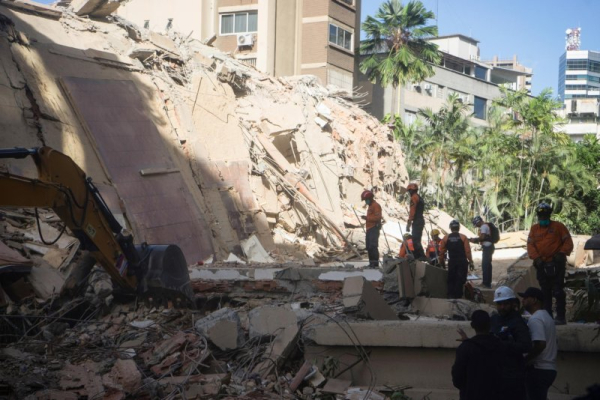
Members of Venezuela’s Civil Defense remove debris and search for survivors at buildings collapsed during the earthquakes in the municipality of Chacao in eastern Caracas, Venezuela, on Thursday. Two earthquakes of magnitude 7.2 and 7.5 struck Venezuela on Wednesday. Photo by Boris Vegraga/EPA
Nearly 40 aftershocks and widespread communications outages have compounded the humanitarian crisis in Venezuela following twin earthquakes measuring 7.2 and 7.5 that struck the country Wednesday, leaving hundreds missing and exposing the fragility of the nation’s emergency response system.
As authorities continue assessing what appears to be Venezuela’s worst natural disaster in decades, government officials and independent organizations say tens of thousands of people remain missing or out of contact amid widespread infrastructure damage and disruptions to basic services.
Venezuela’s interim government, led by Delcy Rodríguez, reported on Thursday a preliminary death toll of 188 people and nearly 1,500 injured nationwide.
With no centralized official registry, civil society groups have created independent online platforms to help locate missing people. One website, desaparecidosterremotovenezuela.com
has received more than 24,800 requests from families searching for relatives who remain trapped or cannot be reached.
Se pueden escuchar voces de personas atrapadas bajo los escombros de un edificio colapsado tras el terremoto en Venezuela. pic.twitter.com/q1XdG64FXv— Alerta Mundial (@AlertaMundoNews) June 25, 2026
Officials said the coastal state of La Guaira has suffered some of the heaviest damage. Rodríguez said dozens of buildings collapsed there as search-and-rescue operations and damage assessments continued across several regions.
The government also announced the creation of a $200 million emergency fund with financing from the International Monetary Fund, while several countries deployed rescue teams and humanitarian aid.
U.S. Secretary of State Marco Rubio said the U.S. response would be “strong, rapid and effective” after speaking directly with Rodríguez, according to NBC and CBS.
SECRETARIO RUBIO: “Tuve la oportunidad de hablar esta mañana temprano con Delcy Rodríguez, la presidenta interina. Ya estamos desplegando equipos de búsqueda y de rescate del condado de Fairfax, Virginia, y de Los Ángeles.” https://t.co/znVtgUHa9j— Embajada de los EE.UU. en Caracas (@usembassyve) June 25, 2026
Rubio said the United States was immediately deploying urban search-and-rescue teams from Virginia and California, providing aerial imagery to assess isolated coastal areas and sending assets to help restore operations at Maiquetía International Airport. He said saving lives during the first “72 golden hours” following the disaster remained the top priority.
The emergency has overwhelmed Venezuela’s already deteriorating infrastructure, exposing years of underinvestment in public services and emergency response systems amid the country’s prolonged economic crisis.
The earthquakes, centered in the central states of Carabobo and Yaracuy, triggered widespread power and natural gas outages, some of them implemented as a precaution to prevent additional accidents.
The country’s already fragile national power grid has slowed restoration efforts. Mobile phone and internet networks have been almost completely disrupted, leaving families unable to communicate and contributing to the growing number of missing-person reports.
Search-and-rescue operations in heavily affected areas, including the Caracas municipalities of Chacao and Altamira and coastal communities in La Guaira, have also been hampered by a lack of specialized equipment.
Years of economic crisis and limited investment have reduced the country’s heavy machinery capacity. Firefighters and Civil Protection crews lack cranes, advanced hydraulic lifting equipment, thermal imaging cameras and motion detectors needed to remove debris and locate survivors efficiently.
In an interview with local radio station Contrapunto, Rodríguez appealed to the private sector to provide heavy construction equipment to accelerate debris removal and rescue operations.
The healthcare system, which was already operating under the conditions of a complex humanitarian emergency, has been overwhelmed by the arrival injured people. Structural damage to at least eight healthcare facilities has forced medical staff to triage and treat patients outdoors on makeshift mattresses set up in public streets, Univision reported.
The United Nations has called for a broad international response. The United States, El Salvador, Mexico, France, Switzerland, Qatar and the Dominican Republic have begun sending specialized rescue teams and emergency supplies to Venezuela, CNN reported.
Aid organizations including Médecins Sans Frontières, also known as Doctors Without Borders, and the International Red Cross have also begun distributing trauma kits and essential medicines in an effort to contain the growing humanitarian crisis.
