


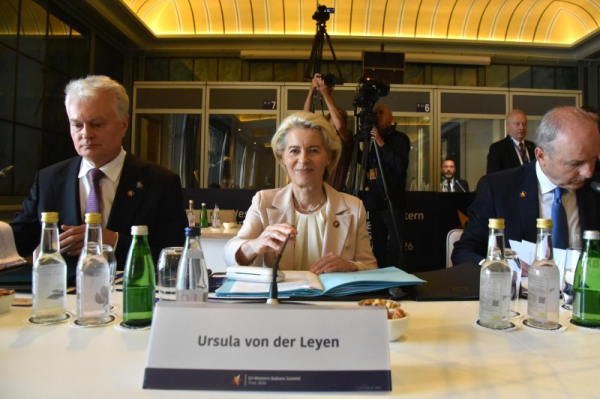
European Commission President Ursula von der Leyen (C) and Lithuanian President Gitanas Nauseda (L) open the EU-Western Balkans summit on Friday in Tivat, Montenegro. Photo by Boris Pejovic
French President Emmanuel Macron, German Chancellor Friedrich Merz and European Commission President Ursula von der Leyen were among more than 30 European leaders gathering in Montenegro on Friday for a summit on EU-enlargement.
Talks at the annual EU-Western Balkans summit in the coastal resort of Tivat will try to reach agreement on the timetable and practicalities of integrating six candidate nations, five in the Balkans plus Ukraine, into the 27-member-country economic and political union.
Speaking after spending the past week in the capitals of the candidates, European Council President Antonio Costa said there was “clear momentum on enlargement” with the formal drafting of Montenegro’s accession treaty underway, Albania on track to complete the 35 “chapters” that form the basis of accession negotiations by the end of 2027, and Moldova and Ukraine cleared to begin formal negotiations to join.
Front-runner Montenegro is optimistic its 18-year wait to join could be realized by 2028 after adopting the euro just three years after its inception — although not the “eurozone” Economic and Monetary Union — and joining NATO in 2017.
Albania is likely next in line despite worries about the job it is doing in cracking down on organized crime and, more recently, implementing the necessary reforms to meet EU environmental standards after the country’s anti-corruption prosecution office opened a probe into a $1.6 billion luxury resort in a protected area that is backed by Jared Kushner, President Donald Trump’s son-in-law.
Other candidates in the region under discussion will be Bosnia-Herzegovina, Kosovo and North Macedonia but political wrangles, domestic and foreign, meant their prospects for EU membership were less clear-cut than those of their neighbours.
“This is proof that reforms by candidates pay off and that the EU is committed to the enlargement process. Enlargement is and will remain merit-based. At the same time, recent proposals show that there is a new willingness to simplify and accelerate the process,” Costa told Politico.
He said the EU’s resolve regarding the Western Balkans was real, as real as the benefits of enlargement which he called a “geostrategic interest for Europe” and an “investment in the peace, stability and security of our continent,” amid efforts by China and Russia to hold sway in the region.
Brussels Institute for Geopolitics researcher Faruk Basic told The Guardian that while the rapidity with which Ukraine’s candidacy was granted following Russia’s full-scale invasion in 2022 demonstrated “real geopolitical urgency” hitherto unseen by the EU, it was now spilt over how Ukraine should join and how quickly, amid fears regarding the costs of reconstruction in Ukraine post-war, which have been estimated at $588 billion.
An interim non-voting associate-type membership proposed by Berlin has not been well received in Kyiv and some European capitals but the European Commission was last month reported to be looking at similar restrictions on other joiners, including withholding the automatic veto rights in major areas such as foreign policy and taxation.
Historic May moments through the years
Wreathes are seen amongst the statues at the Korean War Veterans Memorial during Memorial Day weekend in Washington on May 27, 2023. Memorial Day, which honors U.S. military personnel who died while in service, is held on the last Monday of May. Photo by Bonnie Cash/UPI | License Photo
