

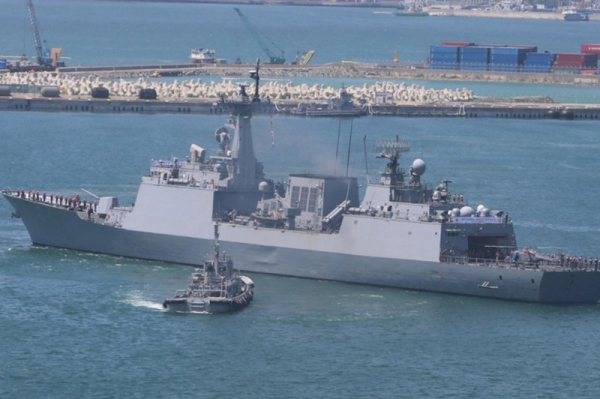
The Dae Jo Yeong, a 4,400-ton South Korean destroyer, departs a naval base for the Gulf of Aden; in Busan, South Korea. File. Photo YONHAP / EPA
South Korean experts said Sunday that any response to U.S. President Donald Trump’s call for allied naval deployments to the Strait of Hormuz should be framed around freedom of navigation and energy security rather than direct military participation.
Trump has urged major energy-importing countries including South Korea, Japan and China to help secure the strategic waterway, arguing that countries benefiting from the route should bear part of the security burden.
Analysts in Seoul said the request reflects Trump’s broader transactional approach to alliances, under which Washington expects partners to share more of the costs of protecting global supply routes.
They warned that South Korea faces a difficult decision between safeguarding vital maritime transport lanes and avoiding the appearance of joining U.S. military operations against Iran.
“Securing a clear rationale based on freedom of navigation should come before any decision on military participation,” South Korean maritime security and military strategy experts said in interviews with Asia Today.
Joo Eun-sik, head of the Korea Institute for Strategic Studies, said Trump’s remarks were not merely rhetorical but amounted to pressure aimed at making U.S. strategic force deployment more efficient.
The Strait of Hormuz remains under threat from what analysts describe as Iran’s asymmetric capabilities, including drones, naval mines and short-range missiles.
Some experts say even the U.S. Navy faces challenges in responding quickly to large-scale mine-laying operations as it transitions away from older mine countermeasure platforms.
Against that backdrop, Washington appears to be seeking a broader operational role from major Asian energy importers to raise pressure on Iran while reducing the burden on U.S. forces.
Japan has drawn particular attention because of its advanced mine-clearing capabilities.
Yoo Ji-hoon, a research fellow at the Korea Institute for Defense Analyses, said Japan’s maritime self-defense forces are widely regarded as having some of the world’s strongest mine countermeasure capabilities, based in part on experience accumulated after World War II.
That leaves Tokyo with a dilemma.
Japan depends heavily on Middle Eastern crude imports, but constitutional limits and its traditionally stable ties with Iran could make any direct military deployment politically contentious at home.
South Korea faces a similar dilemma, with experts saying Seoul should keep open the option of phased or conditional participation rather than rush to send additional combat ships.
South Korea has a precedent. In 2020, Seoul expanded the operational area of the Cheonghae anti-piracy unit to include waters near the Strait of Hormuz and the Arabian Gulf without formally joining a U.S.-led coalition.
Experts said that model may again offer the most practical option.
If South Korea decides to participate, Yoo said, the mission should be presented not as military support under the alliance with Washington but as a responsible contribution to protecting international maritime routes and the country’s own energy security.
That would require clearly limiting any mission to such roles as escorting ships, supporting evacuation operations and sharing information in order to reduce the risk of direct confrontation.
Experts also stressed the importance of carefully defined rules of engagement.
The threat in the Strait of Hormuz is no longer seen primarily in terms of conventional naval warfare but in terms of mines, drones and other asymmetric tactics.
That raises the risk that any South Korean deployment could be perceived as support for U.S. strikes on Iran, potentially increasing danger for South Korean personnel.
Joo said the central issue is not simply whether South Korea participates but under what principles it would operate.
He said Seoul would need a carefully calibrated diplomatic strategy that emphasizes the internationally recognized principle of freedom of navigation while avoiding unnecessary direct confrontation with Tehran.
Analysts said South Korea’s most realistic course is likely neither immediate deployment nor outright refusal, but a policy of strategic patience combined with conditional participation.
They said Seoul now faces the task of managing alliance pressure while refining a diplomatic rationale that would allow South Korea’s maritime security role to be seen internationally as legitimate and limited.
— Reported by Asia Today; translated by UPI
© Asia Today. Unauthorized reproduction or redistribution prohibited.
Original Korean report: https://www.asiatoday.co.kr/kn/view.php?key=20260315010004233
