

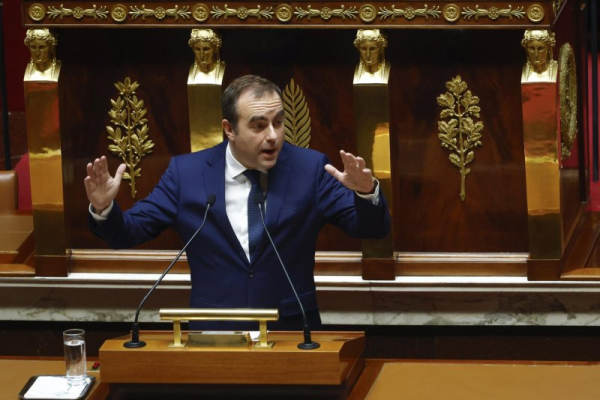
French Prime Minister Sebastien Lecornu makes his pitch to remain in post to lawmakers in the National Assembly in Paris on Thursday ahead of two confidence votes, both of which ultimately failed. Photo by Yoan Valat/EPA
French Prime Minister Sebastien Lecornu survived two confidence votes called by opposition parties on the left and the right in the National Assembly.
The votes just 10 days after Lecornu resigned the first time around saw 271 MPs vote for the first no-confidence motion, 18 short of the 289 required, after winning over the center-left Socialists by suspending Macron’s flagship pension reforms, raising the retirement age from 62 to 64, while retaining the support of Republicans despite being unhappy about ditching the reforms.
The second confidence vote, a censure motion, unveiled by National Rally’s Marine Le Pen immediately after Lecornu named his new cabinet on Sunday, gained only 144 votes after the leftist La France Insoumise party backed down.
“National Rally leader Jordan Bardella attacked MPs who backed Lecornu in the first vote, saying they would be responsible for the suffering that would result.
“A bargaining majority managed to save their seats today at the expense of the national interest,” he said.
Prior to the vote, Le Pen repeated her calls for fresh elections.
“The National Rally awaits the day of dissolution with growing impatience. We can’t wait to return the ballots before the French people,” Le Pen told lawmakers Thursday.
Parliament now revisits the 2026 budget, where conservatives have been pushing to wind in a 5.8% of GDP and growing deficit with tens of billions of euros of spending cuts that the parties on the left have vowed to block.
The budget proved fatal for former Prime Minister Francois Bayrou, who was ousted in a confidence vote in early September after he attempted to force through a spending bill containing $51.6 billion of cuts.
Before him, the same fate befell Michel Barnier in December.
Drafting of Lecornu’s budget was expected to get underway on Monday before being introduced to parliament by Oct. 24, with Lecornu vowing to put it to a vote and not resort to a special constitutional maneuver that would bypass MPs.
Speaking after the votes, Lecornu said he was relieved to be able to get back to work.
“The debates on the budget and other challenges needed to be able to start, and they will start now.”
However, his troubles are not yet over, with the Socialists vowing to rewrite large parts of his budget, making the task of getting it through parliament highly problematic.
