

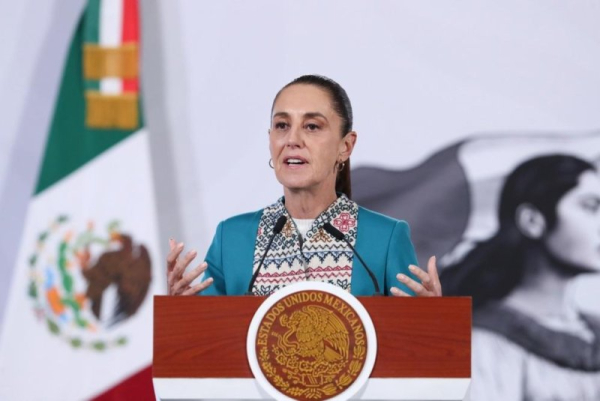
Mexican President Claudia Sheinbaum said the investigation into the oil spill is ongoing. Authorities reported retrieving more than 800 tons of waste across more than 373 miles of coastline. Photo by Mario Guzman/EPA
Fishing communities in the Gulf of Mexico are facing heavy economic losses ahead of usually lucrative Holy Week because of an oil spill that continues to affect the coastline in at least three states.
Authorities are continuing cleanup operations, but have not determined the origin of the oil.
In Veracruz, Tabasco and Tamaulipas, where local economies depend heavily on fishing and tourism, worker in the sector have reduced or suspended activities due to sea contamination and falling demand.
According to press reports and accounts from the region, fishermen have stopped going out to sea to avoid damaging their boats, nets and engines, while consumers avoid buying seafood products out of fear of contamination, during one of the most important periods of the year for these communities.
According to statements by the president of the Federation of Fishing Societies and Cooperatives of Alvarado, Jaime Santiago Rojas, the contingency affects about 50,000 licensed fishermen and a similar number of unlicensed workers in the state of Veracruz alone.
“As it was a very intense hydrocarbon slick, we thought the government would put up a containment barrier to prevent it from spreading,” Rojas told the media in questioning authorities’ response.
According to reports circulated by Sputnik, the oil continues moving toward other areas of the Gulf.
“This year they have not been able to go out, simply no one is buying fish,” residents of affected areas said, according to reports published by Al Jazeera.
An oil spill in the Gulf of Mexico is dealing a heavy blow to fishermen at the height of their busiest season. There is mounting pressure on authorities to determine the source and contain the spill.
Al Jazeera's Julia Galiano reports. pic.twitter.com/8lVVG7hQS1— Al Jazeera English (@AJEnglish) March 31, 2026
Mexican President Claudia Sheinbaum said the investigation into the spill is ongoing. Authorities have reported retrieving more than 800 tons of waste across more than 373 miles of coastline.
“There is still hydrocarbon present in the sea and on some beaches; tar continues to arrive in certain areas, although in smaller quantities,” Sheinbaum said.
pic.twitter.com/YIJwuUbUpi Mañana, la presidenta @Claudiashein se reunirá con un grupo técnico para evaluar el derrame de crudo en el Golfo de México. ️
Aunque se investiga si el origen es una fuga en Cantarell, la hipótesis principal apunta a un fenómeno natural (chapopoteras)….— Emeequis (@emeequis) March 31, 2026
Sheinbaum also said personnel from state-owned oil company Petróleos Mexicanos, the Secretariat of the Navy and the Secretariat of Environment are working continuously in the affected areas.
Specialists warn that the lack of clear information about the origin and magnitude of the spill complicates the emergency response.
Renata Terrazas, director of Oceana Mexico, said authorities have not yet presented definitive conclusions.
“Oil spills are not something that happen once every 1,000 years. Unfortunately, they are constant, but they do not always reach the shore. When they do, that is when they affect coastal communities the most,” she said in an interview with Infobae.
Terrazas stressed the impact is hitting at a critical time for the local economy, as the Holy Week season represents a key source of income for communities that depend on tourism and fishing.
In addition to economic losses, she warned of possible long term effects on Gulf of Mexico marine ecosystems, including coral reefs and vulnerable species, with impacts that could persist in sediments and in the food chain.
