


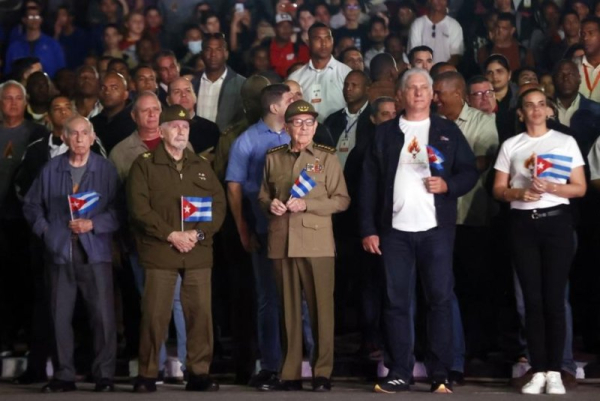
The commander of the Cuban Revolution, Ramiro Valdes (2-L), President of Cuba Miguel Diaz-Canel (2-R) and his predecessor, Raul Castro (C), participate in the traditional Torch March in Havana in January 2025. The Torch March, organized by university students, is held on the eve of the birthday of the independence hero Jose Marti. File Photo by Ernesto Mastrascusa/EPA
The Cuban government confirmed the death of Ramiro Valdés Menéndez, who was one of the last surviving members of the historic generation that came to power alongside Fidel Castro after the 1959 revolution.
A commander in the revolution, a close associate of Ernesto “Che” Guevara and the founder of Cuba’s intelligence services, Valdés was regarded by critics as one of the most powerful and controversial figures in modern Cuban history. He died Sunday at age 94.
Cuban President Miguel Díaz-Canel announced the death and declared a period of official mourning in honor of Valdés, who was recognized by the government as a Hero of the Republic of Cuba.
“The passing of Revolutionary Commander Ramiro Valdés Menéndez hurts deeply, like the loss of a father,” Díaz-Canel wrote on X.
He added that every stage of Valdés’ life “was marked by his absolute loyalty to the leadership of Fidel and Raúl, to his comrades in struggle and to the ideals of the Moncada Program, whose commitment to justice he defended.”
La partida física del Comandante de la Revolución, Ramiro Valdés Menéndez, duele profundamente, como la de un padre.
Así lo quise y respeté siempre. Así recordaré su apoyo y consejos, su discreta colaboración y ejemplar consagración al servicio de la Patria.
1/3 pic.twitter.com/ugQBiaJkfY— Miguel Díaz-Canel Bermúdez (@DiazCanelB) June 21, 2026
Valdés’ death has drawn sharply different reactions inside and outside Cuba, underscoring the divisive legacy of one of the revolution’s most enduring figures.
State media and supporters of Cuba’s political system portrayed him as a symbol of unwavering loyalty to the revolutionary process. His military and political career spanned more than seven decades.
He participated in the 1953 attack on the Moncada Barracks, joined the Granma yacht expedition in 1956 and fought as a guerrilla commander in the Sierra Maestra alongside Guevara.
After the revolution’s victory in 1959, Valdés held some of the highest positions in government, serving multiple terms as interior minister, minister of information technology and communications and vice prime minister. He remained a member of the Political Bureau of the ruling Communist Party of Cuba until 2019.
In recent months, he continued to play a role in overseeing Cuba’s severe energy crisis, maintaining his status as a trusted figure within the country’s leadership.
Independent Cuban media outlets and human rights advocates offered a starkly different assessment. Organizations and publications including Martí Noticias, Diario de Cuba, CiberCuba and 14ymedio described Valdés as a central architect of state repression on the island.
Opponents say that, as founder of the Interior Ministry in 1961, Valdés helped build Cuba’s intelligence, counterintelligence and domestic surveillance apparatus with assistance from the former Soviet Union’s KGB.
Critics also accused him of playing a key role in censorship and digital surveillance efforts used to monitor activists and dissidents.
Dissident groups have long linked Valdés to political persecution, interrogations and the imprisonment of government opponents.
“Ramiro Valdés leaves no legacy of glory. He leaves a legacy of fear, persecution, prisons, informants and pain,” Cuban journalist Mario J. Pentón wrote.
International critics likewise argued that Valdés died without facing legal accountability for alleged human rights abuses committed during his decades in power.
“It is unfortunate that Ramiro Valdés died without ever having to answer for the countless crimes against humanity, acts of torture and abuses committed against the Cuban people,” Cuban American Rep. Carlos Giménez wrote on X.
#SOSCuba Pena que el esbirro Ramiro Valdés falleció sin nunca tener que enfrentar la justicia por los innumerables crímenes de lesa humanidad, torturas y aberraciones que cometió en contra del pueblo cubano.— Rep. Carlos A. Gimenez (@RepCarlos) June 21, 2026
Valdés’ death further reduces the number of surviving leaders of the 1959 revolution. The movement’s historic leadership is now largely represented by former President Raúl Castro, 95, and Commander Guillermo García Frías.
As Cuban authorities prepare official honors, many members of the Cuban diaspora and opposition groups used social media to express relief at the passing of a figure they associated with some of the most feared chapters in the history of Cuba’s state security apparatus.
