

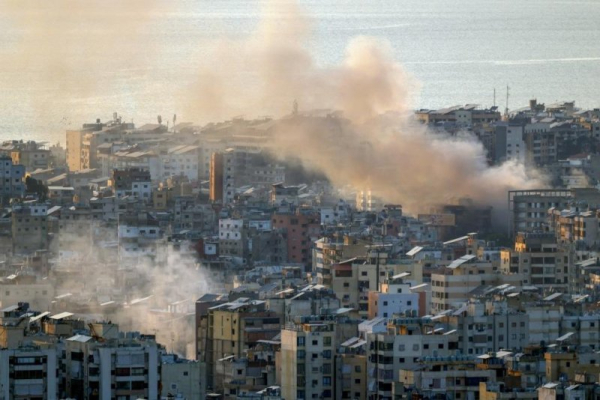
Smoke rises from destroyed buildings after Israeli strikes in the southern suburbs of Beirut, Lebanon, on Tuesday. The Israeli military stated it is conducting strikes across the country targeting Hezbollah infrastructure and personnel. Photo by Wael Hamzeh/EPA
Israel resumed heavy strikes on Beirut’s southern suburbs and other areas Tuesday as its troops advanced into southern Lebanon, while Iran-backed Hezbollah continued targeting northern Israel with missiles for the second consecutive day.
Hezbollah said in separate statements that it had launched missiles and drones at Israeli military positions in northern Israel, including the Ramat David Airbase, in response to Israel’s “criminal aggression” against Beirut’s southern suburbs and southern Lebanon that killed dozens of civilians, including women and children.
According to the statements, an Israeli drone was downed over the southern market town of Nabatiyeh, while an Israeli Merkava tank was targeted in the Kfar Shouba hills.
The Israeli Army confirmed that it has conducted a wave of strikes on Hezbollah communication and intelligence infrastructure in the southern suburbs, including the group’s elite Radwan forces, military command centers and Al-Nour radio station.
Israeli English-language websites quoted the Army that most Hezbollah rockets landed in the sea or open areas, with one rocket shot down, while two drones were intercepted.
In a new development, the Israeli Army said it deployed ground troops deeper into southern Lebanon, beyond the five posts it currently occupies, and seized several positions across the border.
It described the move as reinforcing forward defenses and said it aims to create “an additional security layer” for residents in northern Israel and prevent infiltration attempts.
Israeli Defense Minister Israel Katz said that he and Prime Minister Benjamin Netanyahu authorized the Army to advance and take control of additional strategic positions “to prevent direct fire on Israeli communities.”
However, the Army’s Northern Command said that it was unlikely to initiate a larger ground invasion into Lebanon until the situation with Iran was calmer, if at all.
The Israeli advance prompted the Lebanese Army to redeploy its soldiers from newly established border positions back to their bases. It also led President Joseph Aoun to call French President Emmanuel Macron, requesting France’s intervention to halt Israel’s military expansion.
Aoun confirmed that Hezbollah fired missiles outside the southern Litani area, where the Army is deployed, and took control of Hezbollah positions.
He said that the decision to bar Hezbollah from any military and security activities is “a sovereign, final decision that cannot be reversed,” which the army and security forces will implement.
Meanwhile, the Lebanese health minister announced a new casualty toll from the recent escalation, saying that 40 people, including seven children, have been killed and 246 wounded since Monday, bringing the total since the Nov. 27, 2024, cease-fire arrangements to 437 killed and 1,348 wounded.
As Israel issued additional evacuation orders Tuesday for dozens of villages in southern Lebanon, many displaced residents remained stuck in heavy traffic while fleeing to safety, forced to sleep in their cars and spend the night on the roadside.
Most of them left immediately, without having time to take any essential belongings or medicine, prompting residents in the city of Sidon and along the road to Beirut to offer them water and food while they were stuck in their cars.
Minister of Social Affairs Haneen Sayed said the number of displaced people registered in shelter centers has reached 58,064, noting that 52 out of 321 shelters have reached maximum capacity.
Sayed urged the remaining displaced people to move to Mount Lebanon and the northern regions, while efforts are underway to address needs across the country.
She said all state institutions are on full alert, noting that “the challenge is significant, but we are implementing a clear plan to ensure a rapid and organized response.”
The U.N. refugee agency, (UNHCR, reported “heavy displacement” across southern Lebanon, the eastern Bekaa Valley, and the southern suburbs of Beirut after Israeli evacuation warnings.
The agency also noted an increased number of Syrian refugees returning to their country, with around 11,000 crossing the border Monday — higher than the daily average — in anticipation of a possible influx from Lebanon.
