

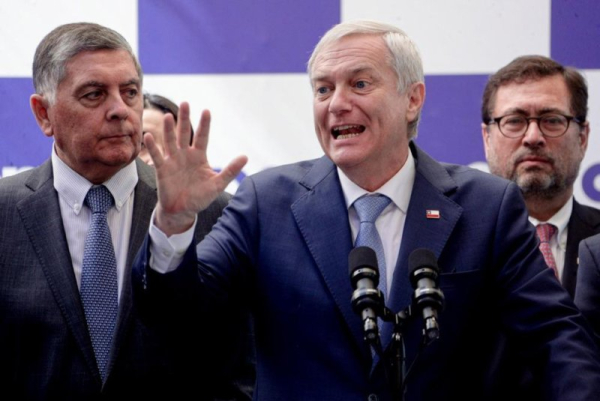
Chile’s president-elect, Jose Antonio Kast (C), speaks at a press conference in Santiago, Chile, on Tuesday. He declared the transition process, which began in December with outgoing President Gabriel Boric, over after the cancellation of their scheduled meetings and amid mutual accusations of a lack of transparency and alleged misstatements about the cable project between China and Chile. Photo by Ailen Diaz/EPA
A Chinese-backed submarine fiber-optic cable project has triggered a diplomatic dispute and an unprecedented political rift in Chile just days before the country’s presidential transition.
The Chile China Express cable project, supported by state-owned China Mobile, has drawn criticism from the United States, which accused Chile of jeopardizing its own security and that of the region by moving forward with the initiative.
Tensions escalated during a meeting Tuesday between outgoing President Gabriel Boric and President-elect José Antonio Kast intended to coordinate the transfer of power. The 22-minute meeting ended abruptly amid disagreements over the sharing of information related to the controversial project and other state matters.
Weeks before Boric leaves office, the United States revoked visas for three Chilean government representatives, citing their role in directing and supporting activities that compromise critical telecommunications infrastructure.
In a televised interview, Boric said he had contacted the president-elect to provide details about the Chinese project before the United States imposed the sanctions. Kast denied that any such exchange took place — a dispute that affected preparatory activities for the change in administration.
After the failed meeting, Kast ended the scheduled bilateral sessions between his future Cabinet members and the outgoing administration, marking a rupture unseen since Chile’s return to democracy in 1990.
Chilean authorities have said the project remains under evaluation. However, on Jan. 27, the Ministry of Transport and Telecommunications approved a 30-year concession to install and operate a transmission network spanning 19,873 kilometers across the Pacific Ocean between Chile and Hong Kong. The decree was revoked two days later.
“The dispute between President Boric and the president-elect regarding the submarine cable reveals several errors and omissions, as well as information that this government did not disclose in a timely manner. Unfortunately, this situation has generated a climate of mistrust, especially considering the ties some ruling party figures have had with China,” lawmaker Joanna Pérez said.
On Monday, the Chamber of Deputies’ Public Works, Transport and Telecommunications Committee approved a request urging the Foreign Ministry to seek the withdrawal of U.S. Ambassador to Chile Brandon Judd. The request remains under review.
“We are a dependent country, even if it is said otherwise, but we are dignified. That is what I am demanding here: the dignity of our people, of our authorities, of our president, who submit to what the U.S. ambassador in Chile said or instructed, and it is not the first time,” lawmaker René Alinco said during the committee session.
The dispute has also prompted a response from Beijing. In a statement, China’s government said the trans-Pacific cable project does not affect the interests of third countries or Chile and accused the United States of seeking to maintain a monopoly over international telecommunications.
“Above all, China and Chile are very important partners,” China’s ambassador to Chile, Niu Qingbao, told Radio Biobio. He said there is a strong need to improve connectivity between the two countries and between Chile and Asia more broadly.
“Any project must comply with the laws of each country. Projects such as this submarine cable fully comply with Chilean law and do not harm any third party, so they will not undermine regional security or the security of other countries,” he said.
