

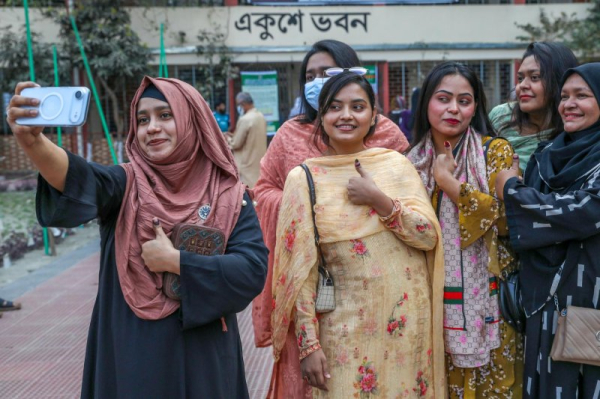
Young women celibrate casting their votes in Thursday’s election with a selfie showing their inked thumbs outside a polling station at Dhaka Government Muslim High School in Dhaka, Photo by Monirul Alam/EPA
The Bangladesh Nationalist Party secured a resounding victory on Friday, winning a more than two-thirds majority in the country’s first election since the previous administration was toppled by mass anti-government protests in 2024.
With vote counting almost complete, the BNP won 212 of the 300 seats being elected to parliament, putting party chairman Tarique Rahman on track to become prime minister.
Just under 60% of the 127 million people eligible to vote turned out in Thursday’s poll.
An 11-party coalition led by the previously banned Jamaat-e-Islami, the country’s largest Muslim party, came in some way behind, winning 77 seats so far, amid allegations of irregularities in the way the election was run, despite the performance being its strongest ever.
Jamaat-e-Islami said there had been “repeated inconsistencies and fabrications in unofficial result announcements,” while the banned Awami League of exiled former prime minister Sheik Hasina questioned how an election without the opposition could be free and fair.
Hasina, who fled to India in 2024 after a brutal crackdown on protests by her security forces killed as many as 1,400 people, was sentenced to death for crimes against humanity by a Dhaka court in November after a trial-in-absentia.
With 40% of the population under the age of 25, many Bangladeshis have never known any other leader than Hasina, who clung to power for 15 years through increasingly repressive means.
Voters also backed sweeping constitutional changes to limit executive power and add more checks and balances into the political system in a referendum vote that ran alongside Thursday’s parliamentary election.
“This victory was expected. It is not surprising that the people of Bangladesh have placed their trust in a party capable of realising the dreams that our youth envisioned during the uprising,” said leading BNP committee member Salahuddin Ahmed.
Ahmed urged supporters to refrain from overexuberance or any grandstanding, saying the monumental task facing the new administration made excessive victory displays inappropriate.
“This is not a time for celebration, as we will face mounting challenges in building a country free from discrimination,” he said.
Rahman, 60, who only returned to Bangladesh in December after 17 years in exile in London, ran pledging a new era of democracy, politics people could trust and a “top down, no tolerance” approach to stamping out graft.
Transparency International ranked Balngladesh as 150th out of 182 countries in its most recent Corruption Perceptions Index published on Tuesday.
Rahman is a scion of one of the country’s two main political dynasties, the other being that of Sheik Hasina, daughter of Sheikh Mujibur Rahman, the founding father and first president of Bangladesh.
Tarique Rahman’s father, Ziaur Rahman, was one of the leading figures in the country’s battle for independence from India and served as president from 1977 until he was assassinated in 1981. His mother, Khaleda Zia, was Bangladesh’s first woman prime minister, serving two terms.
Khaleda Zia did not live to see her son become prime minister, passing away in a Dhaka hospital on Dec. 30 at the age of 80.
