

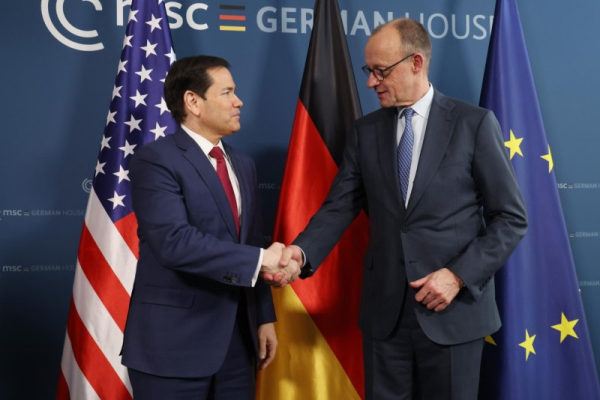
U.S. Secretary of State Marco Rubio (L) is greeted by German Chancellor Friedrich Merz at the Munich Security Conference on Friday. Photo by Sean Gallup/EPA
U.S. Secretary of State Marco Rubio warned the old world had been replaced with a new era in geopolitics that would require fresh thinking and for respective nations to reassess their roles.
Speaking Thursday before departing Washington at the head of a U.S. delegation to the Munich Security Conference, the first big trans-Atlantic gathering since President Donald Trump threatened to annex Greenland, vowed to be honest with European allies about the United States’ priorities.
“I think they want — honestly, they want to know where we’re going, where we’d like to go, where we’d like to go with them… I think it’s at a defining moment. The world is changing very fast right in front of us. The old world is gone — frankly, the world that I grew up in — and we live in a new era in geopolitics, and it’s going to require all of us to sort of reexamine what that looks like and what our role is going to be,” said Rubio.
“We’ve had many of these conversations in private with many of our allies, and they are our allies, and we need to continue to have those conversations. And I think Saturday, hopefully, and the meetings we’ll have there will move us in that direction,” he added.
Trans-Atlantic relations were thrown into crisis in January after Trump reiterated his intention to take over Greenland, which is part of NATO member Denmark, and threatened to impose tariffs on European allies that opposed the plan.
Tensions have since calmed after Trump backed off, telling an audience of global political and business leaders attending the World Economic Forum in Switzerland on Jan. 21 that he would not use force and that he was canceling tariffs as high as 25% due to take effect Feb. 1.
That didn’t stop European Union lawmakers from indefinitely shelving a vote to approve a trade deal struck with the United States in July, with the Greenland debacle being increasingly seen by Europe as a “wake-up call” demonstrating the clear and present risks confronting the once rock-solid relationship.
French President Emmanuel Macron has been leading the charge for Europe to reduce dependence on the United States for protection and solutions to global issues, saying the continent must take its destiny into its own hands and begin behaving like “a power.”
German Chancellor Friedrich Merz revealed Friday he had held “confidential talks” with Macron about developing a European nuclear deterrent, independent of the nuclear umbrella provided by the United States, despite international treaties prohibiting Germany from acquiring nuclear weapons.
Britain and France are the only two European countries with nuclear weapons.
Other figures, including German Foreign Minister Johann Wadephul, Dutch Foreign Minister David van Weel and NATO Secretary General Mark Rutte stressed the necessity of preserving the relationship by stepping up security-wise while showing the United States it also needed Europe.
Danish Prime Minister Mette Frederiksen said she would meet with Rubio to discuss Greenland.
In an open letter on Friday, eight former US ambassadors to Nato and eight former American supreme commanders in Europe urged the United States not to give up on NATO, calling it a “force multiplier,” imbuing it with the ability to project power and influence more effectively and farther afield, at less cost than acting alone.
Alarm bells were first set ringing after U.S Vice-President JD Vance launched a scathing attack on Europe at last year’s conference, accusing countries of restricting free speech, allowing mass migration to go unchecked and retreating from some of the “most fundamental values it shares with the United States.”
This week in Washington
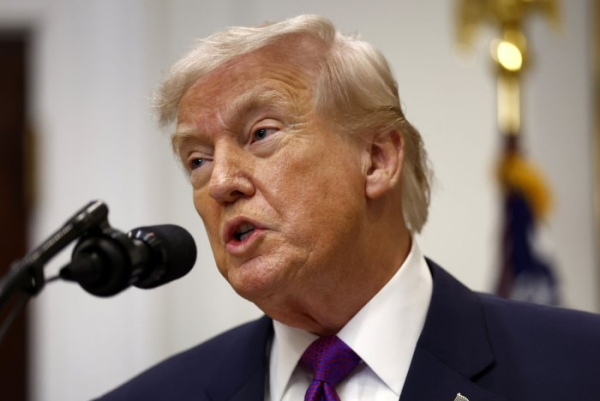
President Donald Trump speaks alongside Administrator of the Environmental Protection Agency Lee Zeldin in the Roosevelt Room of the White House on Thursday. The Trump administration has announced the finalization of rules that revoke the EPA’s ability to regulate climate pollution by ending the endangerment finding that determined six greenhouse gases could be categorized as dangerous to human health. Photo by Will Oliver/UPI | License Photo
