

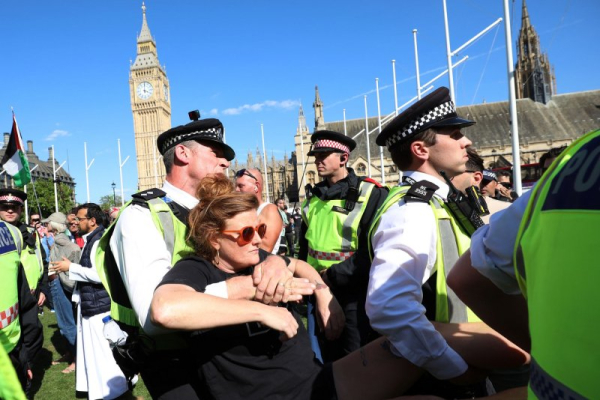
1 of 6 | Metropolitan Police arrest people who support Palestine Action, which has been classed as a terrorist group, in August. On Friday, the High Court in London ruled that the British ban against the organization is unlawful. File Photo by Hugo Philpott/UPI | License Photo
The British government’s ban on protest organization Palestine Action under anti-terrorism laws was ruled unlawful by three judges, who said the move was disproportionate and breached free speech rights.
The High Court in London said the ban could stay in place for now to allow the government time to appeal and for the court to hear legal arguments. But London’s Metropolitan Police said it will not arrest protesters for expressing their support for the group, but it would still gather evidence for possible enforcement “at a later date.”
“We will continue to take an assertive and determined approach to dealing with anti-Semitism and other hate crime, acting decisively against anyone who tries to use the cover of protest to cause fear and distress to Londoners,” the Met said in a statement.
The pro-Palestinian group was designated a terrorist organization in July by Prime Minister Keir Starmer’s government.
Several members of the group were imprisoned for their expressed support or membership in the group, and many went on a hunger strike to protest the U.K.’s actions in Israel. They ended their hunger strike in mid-January after the government decided not to give a $2.7 billion project to the U.K. subsidiary of Israeli defense contractor Elbit Systems, which was one of the group’s demands. One activist had been striking for 73 days.
There were more than 2,500 members of the group were arrested, and their fate is unknown because Home Secretary Shabana Mahmood said she would appeal the decision.
Co-founder of Palestine Action, Huda Ammori, called the ruling a “monumental victory.” She filed the suit with the High Court.
“We were banned because Palestine Action’s disruption of Israel’s largest weapons manufacturer, Elbit Systems, cost the corporation millions of pounds in profits and to lose out on multibillion-pound contracts,” Ammori told The Guardian.
“We’ve used the same tactics as direct action organizations throughout history, including anti-war groups Keir Starmer defended in court, and the government acknowledged in these legal proceedings that this ban was based on property damage, not violence against people. Banning Palestine Action was always about appeasing pro-Israel lobby groups and weapons manufacturers, and nothing to do with terrorism,” she added. “Today’s landmark ruling is a victory for freedom for all, and I urge the government to respect the court’s decision and bring this injustice to an end without further delay.”
It’s the first time a group designated a terrorist organization has successfully challenged it in court.
Victoria Sharp, the lead judge who wrote the decision, acknowledged that Palestine Action “promotes its political cause through criminality and encouragement of criminality.”
“The court considered that the proscription of Palestine Action was disproportionate. A very small number of Palestine Action’s activities amounted to acts of terrorism within the definition of section 1 of the 2000 act [Britain’s Terrorism Act of 2000]. For these, and for Palestine Action’s other criminal activities, the general criminal law remains available. The nature and scale of Palestine Action’s activities falling within the definition of terrorism had not yet reached the level, scale and persistence to warrant proscription,” she added.
Green party leader Zack Polanski said, “It is time for the government to stop criminalizing the people protesting a genocide,” The Guardian reported.
Home affairs spokesperson and Liberal Democrat member Max Wilkinson said, “Placing Palestine Action in the same legal category as ISIS was disproportionate.”
The group broke into a Royal Air Force base in June and damaged two planes in protest of Britain’s involvement in Israel. It also allegedly vandalized President Donald Trump’s Turnberry golf course in Ayrshire, Scotland, in March because of his support for Israel and call to relocate Gazans. They sprayed red paint and graffiti on buildings and other structures on and near the golf course, dug dozens of holes on one fairway and painted “Gaza Is Not 4 Sale” on another.
In December, London police arrested Swedish activist Greta Thunberg for allegedly holding a protest sign supporting Palestine Action hunger strikers.
Thunberg, 22, allegedly sat with a handwritten sign that said, “I support the Palestine Action prisoners. I oppose genocide.”
