

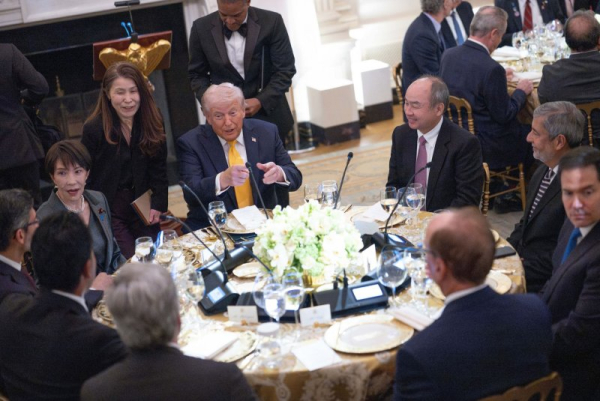
President Donald Trump (R) sits with Prime Minster Sanae Takaichi of Japan during a dinner in the State Dining Room of the White House in Washington, DC, on Thursday, March 19, 2026. Earlier in the day, the President and Takeuchi exchanged views on Iran, energy, and issues in the Indo-Pacific region. Photo by Aaron Schwartz/UPI | License Photo
Japanese Prime Minister Sanae Takaichi said Japan cannot deploy its Self-Defense Forces to the Strait of Hormuz under current conditions, citing constitutional limits, even as the United States presses allies to contribute to maritime security.
During a summit in Washington last week with President Donald Trump, Takaichi said Japan’s actions must remain within the bounds of its laws, referring to Article 9 of the Constitution, which restricts military activity.
“There are things Japan can and cannot do within the scope of the law,” she told reporters after the meeting, emphasizing legal constraints on overseas deployment.
Takaichi agreed that ensuring safe navigation through the Strait of Hormuz is critical but indicated that dispatching forces to an active conflict zone would be difficult under current constitutional interpretations.
Trump has urged allies, including Japan, South Korea and European nations, to play a more active role in securing the strait, a vital route for global energy supplies. He has warned that countries dependent on Middle Eastern oil should take responsibility for protecting their own energy lifelines.
While stopping short of outright rejection, Japan signaled it would not send naval forces to the region at this stage. Instead, officials left open the possibility of participating in post-conflict mine-clearing operations, which are considered non-combat activities.
Foreign Minister Toshimitsu Motegi said Japan’s mine-clearing capabilities are among the best in the world and could be considered if a ceasefire is reached and maritime hazards remain.
The Japanese government is also exploring alternative ways to support stability without military deployment. These include expanding imports of U.S. energy resources, investing in supply infrastructure and drawing on strategic oil reserves.
Officials said Japan holds reserves equivalent to more than 250 days of supply and is considering measures such as diversifying import sources and increasing purchases of U.S. crude oil and natural gas.
The approach reflects an effort to balance domestic legal constraints with alliance expectations. Takaichi faces pressure at home from opposition parties and public opinion, while also navigating Washington’s calls for greater burden-sharing.
The government has said it is reviewing what actions are legally permissible, leaving open the possibility of future adjustments depending on developments in the conflict and domestic political conditions.
— Reported by Asia Today; translated by UPI
© Asia Today. Unauthorized reproduction or redistribution prohibited.
Original Korean report: https://www.asiatoday.co.kr/kn/view.php?key=20260323010006733
