
The former Japanese prime minister says Seoul and Tokyo should expand cooperation on supply chains, energy, AI and shared social problems.


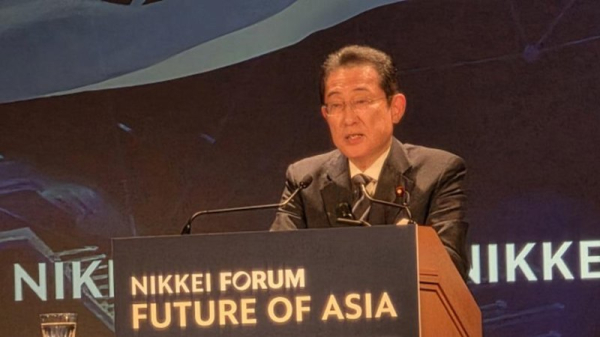
Former Japanese Prime Minister Fumio Kishida delivers a keynote speech at a South Korea-Japan special session of the Nikkei Forum in Tokyo on Tuesday. Photo by Asia Today
Former Japanese Prime Minister Fumio Kishida said Tuesday that South Korea and Japan have become partners that can grow together and help maintain peace and stability in the Indo-Pacific.
Kishida made the remarks in a keynote speech at a South Korea-Japan special session of the 31st Nikkei Forum “Future of Asia” at the Imperial Hotel in Tokyo.
“South Korea and Japan are now partners that grow together and work in coordination to fulfill their roles for peace and stability in the Indo-Pacific region,” Kishida said.
The special session was held under the theme of “multi-layered economic cooperation supporting a solid South Korea-Japan relationship.” Kishida attended the session with former National Assembly Speaker Kim Jin-pyo and business leaders from both countries.
Kishida said relations between South Korea and Japan were in “a very severe state” when he became prime minister in 2021, with even summit meetings difficult to arrange.
He said he believed it was strategically important to stabilize bilateral ties and work with South Korea to shape the future amid an increasingly complex international environment. He said he began with informal meetings and continued communication with South Korean officials.
“The accumulation of such dialogue gradually melted the snow that had piled up between South Korea and Japan and led to the resumption of shuttle diplomacy in 2023,” Kishida said.
Kishida said he held 12 in-person summit meetings with South Korean leaders during his time as prime minister. Through frank exchanges between the leaders, he said, the two countries were able to restore a more desirable form of bilateral relations.
He said future-oriented progress was possible on difficult issues because trust had been built between the leaders of the two countries. He cited disputes involving wartime laborers from the Korean Peninsula, the listing of the Sado mine as a UNESCO World Heritage site and Japan’s release of treated water from the Fukushima Daiichi nuclear power plant.
Kishida said cooperation between South Korea and Japan has expanded into economic and social fields.
He cited the South Korea-Japan and Japan-South Korea Future Partnership Fund, led by the Japan Business Federation, known as Keidanren, and the Federation of Korean Industries, as a representative example of economic cooperation.
Kishida also emphasized trilateral cooperation among South Korea, Japan and the United States.
He said the Camp David summit greatly advanced trilateral ties, and cooperation has continued to strengthen in security, economic security and other areas.
Kishida said exchanges between business leaders in the two countries are helping build a stable and future-oriented bilateral relationship. He said the two governments should support business exchanges, including youth talent programs and joint industrial projects under the future partnership fund.
The first task Kishida identified was strengthening supply chains.
He said making supply chains more resilient and diversified, including those for critical minerals, and securing strategic autonomy have become urgent priorities.
Kishida said South Korea and Japan agreed in March through a supply chain partnership memorandum to cooperate on preparing for supply chain disruptions, recovering from disruptions and responding to issues involving critical minerals and excess supply.
Energy cooperation was also presented as a core agenda item.
Kishida said South Korea and Japan have similar energy supply structures and are closely connected to regional supply chains. For that reason, he said, it is essential for the two countries to respond together to energy issues.
He referred to the Asia Zero Emission Community, or AZEC, which was launched during his tenure as prime minister. He said South Korean Prime Minister Kim Min-seok attended an online AZEC Plus summit in April on strengthening Asian energy and critical goods supply chains.
Kishida also cited recent progress from South Korea-Japan summit diplomacy, including stronger energy security under the “Power Asia” initiative announced by Japanese Prime Minister Sanae Takaichi. He said the initiative includes strengthening energy supply resilience in the Indo-Pacific and enhancing South Korea-Japan energy security through mutual flexibility and swap transactions involving crude oil, petroleum products and liquefied natural gas.
Kishida said such cooperation will help secure energy supply chains and is based on an evolved vision of a free and open Indo-Pacific.
He also raised cooperation in AI and quantum technology.
Kishida said quantum technology is important from the standpoint of economic security and that cooperation is moving forward among South Korea, Japan and the United States.
On AI, he described the field as “both a new challenge and an area with great potential.” He said he hopes South Korea-Japan cooperation in AI will become more concrete.
Kishida also said the two countries should work together on shared social challenges.
He said South Korean and Japanese leaders agreed at a summit in August to launch a consultation framework to address common problems, including overconcentration in capital regions, low birthrates, aging populations and disaster prevention.
Kishida said solving social problems will require the insight of business leaders and the flexible thinking of young entrepreneurs. He called for public-private cooperation between the two countries.
“I am very pleased that the good trend in South Korea-Japan relations is being maintained, including the continuation of shuttle diplomacy between the leaders of the two countries,” Kishida said.
He said he feels great hope for the future of South Korea-Japan relations whenever he sees many young people traveling between the two countries and enjoying exchanges.
“South Korea and Japan, together with the Indo-Pacific, must fulfill their roles together for a more resilient and prosperous Asia,” Kishida said. “I will also work hard with all of you.”
— Reported by Asia Today; translated by UPI
© Asia Today. Unauthorized reproduction or redistribution prohibited.
Original Korean report: https://www.asiatoday.co.kr/kn/view.php?key=20260609010003042
