


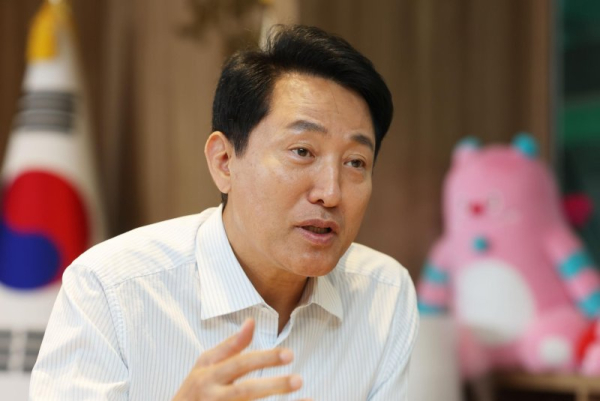
Seoul Mayor Oh Se-hoon vowed to prioritize elevating Seoul into a global top-three city after winning reelection last week. Oh is seen here during an interview with Yonhap News Agency at his office in central Seoul on Tuesday. Photo by Yonhap
Seoul Mayor Oh Se-hoon has vowed to prioritize elevating Seoul into a “global top three city” during his new term following his victory in the June 3 local elections.
Oh made the pledge in an interview with Yonhap News Agency on Tuesday after winning last week’s local election against ruling Democratic Party rival Chong Won-o, his third consecutive and fifth non-consecutive election as Seoul mayor.
“A global top three city is not merely a slogan to raise the ranking but a goal to increase quality of life,” Oh said at his office. “(I) will concentrate the new city government’s capabilities to create a warmer and healthier Seoul.”
Seoul ranked sixth in the Japan-based Mori Memorial Foundation’s Global Power City Index 2025. London topped the list followed by Tokyo, New York, Paris and Singapore.
The index evaluates cities based on six major indicators — economy, research and development, cultural interaction, livability, environment and accessibility.
Oh said he plans to establish a committee to achieve the “global top three city” goal, noting that it will serve to set the direction of the city government for the next four years.
“If (we) continuously work on areas that the city can be good at and can handle, Seoul can rise to a global top three city rivaling London, New York, Tokyo, Paris and Singapore,” he said.
Meanwhile, Oh said he has no plans set up for the presidency, even after his victory cemented his place as a political heavyweight with his party suffering a rout in last week’s elections, winning only four out of 16 key mayoral and gubernatorial seats up for grabs.
“There is no plan for the presidency,” he said, pledging to focus on elevating the city’s status. “(I) don’t think politics works out just by making plans.”
Copyright (c) Yonhap News Agency prohibits its content from being redistributed or reprinted without consent, and forbids the content from being learned and used by artificial intelligence systems.
