

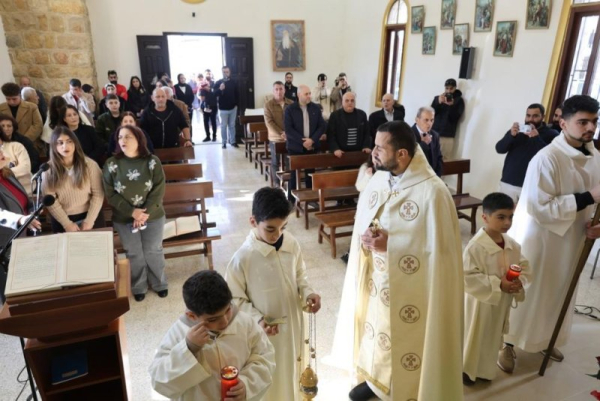
The faithful attend a Christmas mass at the damaged St. Anthony church in Al-Khiyam, southern Lebanon, on December 25. This is the first Christmas mass in the town since a cease-fire was agreed to between Lebanon and Israel in late November 2024 to halt more than a year of cross-border fighting with Hezbollah. Photo by EPA
Celebrating Christmas, New Year, or any other holiday — or even summer vacation — has always been a challenge for Lebanese living abroad and their families back home. The constant fear of war, violence and insecurity leaves them with the same last-minute question every time: Is it safe to go there?
This year, Lebanese determination to celebrate the end-of-year holidays was exceptional, despite Israel’s continued strikes and threats of a wider war.
Christmas went ahead in full swing, with illuminated trees lighting up major cities and towns, and more than 45 festivals and markets across the country.
The holiday season reached its climax in mid-December with a surge of Lebanese in the diaspora, many making last-minute decisions to travel home as reports circulated that Israel had eased its warnings of a wider escalation against Hezbollah and the Lebanese state.
They were joined by a growing number of Arab and foreign tourists, giving a much-needed boost to Lebanon’s tourism and economy.
With an average of 25,000 arrivals each day — a more than 75% increase compared to last year — flights were fully booked, and Beirut’s Rafic Hariri International Airport was packed with families welcoming their loved ones.
Pope Leo XIV’s visit to Lebanon earlier this month, along with ongoing direct negotiations with Israel, also helped create a sense of reassurance, easing fears and hesitation about traveling to the country.
Badia Sammak, a mother of three who has been living in the Saudi city of Riyadh for 35 years, was visiting her two daughters in New York when they “pushed” her to make the spontaneous decision to spend the holidays in Lebanon.
Her daughters, Leah and Diane, had been longing to return after six years away, eager to reconnect with family, friends and the familiar warmth of home.
They didn’t regret it for a minute.
“I was afraid, but the moment we stepped into Beirut’s airport, the festive spirit changed everything,” Sammak told UPI. A band played lively tunes, sweets were handed out and families embraced returning children.
She explained that uncertainty, hesitation and fear always dominate when planning a trip to Lebanon — making it almost impossible. “We simply cannot decide; every time, something comes up.”
Most Lebanese feel a deep, enduring urge to return home, having been forced to flee war or economic hardship.
This was the case of Stephanie Salameh, who moved to Germany with her husband and daughter a few years ago, having had enough of the deteriorating situation in the country.
The Beirut port explosion on Aug. 4, 2020, which devastated large parts of the capital, killed 218 people and wounded more than 6,000, was the “cherry on the cake,” said Salameh, a 43-year-old people’s coordinator manager at a company in Hamburg.
“We, the Lebanese, have never lived in security. … The wars and all the explosions that ripped through the country over many years left me with trauma. For sure, I never wanted my daughter to endure the same,” she told UPI.
She has been unable to return to the country for two Christmases because of the war that began when Hezbollah opened a support front for Gaza on Oct. 8, 2023.
The conflict continues despite a cease-fire reached in November 2024. Israel remains determined to fully disarm Hezbollah, carrying out almost daily airstrikes that cause further deaths and destruction. The Iran-backed group has refrained from retaliation, having been greatly weakened during the war, but is vowing a comeback.
Choosing to live day by day, Salameh resolved to silence her fears and join her mother for Christmas this year. Her husband, too, needed to see his family.
This time, she booked their flights with Lebanon’s Middle East Airlines, the only carrier that continued to operate at the peak of the war and despite Israeli strikes near the airport.
“Although the tickets were more expensive, we could be sure, or at least expect, we would be back at work in Germany on time,” she explained.
Staying tuned to the news is common among the Lebanese, whether at home or abroad. It can influence almost every plan, help evaluate risks and shape every decision.
Sammak chose to end her family’s year-end stay and leave Lebanon on Jan. 7 — simply because she calculated that on that day the Lebanese Army commander would deliver his final report on the first phase of disarming Hezbollah in the southern region.
Like many, she fears Israel will then follow through on its threats to expand the war on Hezbollah to force its immediate and complete disarmament.
For that reason, almost everyone seems eager to enjoy the moment, with restaurants, hotels and live concerts already fully booked for New Year’s Eve.
Pierre Achkar, president of Lebanese Hotel Association, estimated hotel occupancy rates in Beirut and at ski resorts to be between 80% and 100%, while occupancy outside the capital ranged from 60% to 80%. Room prices varied between $50 and $600 per night.
Achkar said many Lebanese visitors preferred to stay at hotels rather than in their own homes this year.
With more tourists coming from Syria, Iraq, Egypt, Jordan, Kuwait, Qatar and United Arab Emirates, as well as from Europe, he said “this is the best year” since Lebanon’s 2019 financial collapse, the COVID-19 pandemic, the Beirut port explosion and the recent Israel-Hezbollah war.
“Hotel reservation requests started flooding in from everywhere when news spread that Israel had postponed its large-scale attack on Lebanon,” Achkar told UPI. “Those who were hesitant quickly changed their minds.”
He argued that even amid the ongoing war, Lebanon remained “a reliable and consistent tourist destination,” referring to the Lebanese will “to make their country prosperous again.”
For the tourism sector — and the economy — to flourish again, he emphasized that the country needs long-term stability and large-scale reforms, particularly in the judiciary and administration, to attract much-needed investment and create job opportunities.
That would also allow many Lebanese living abroad, who miss their country, to return.
To Sammak, who is struggling like many others in the displacement, Lebanon could be the place for her and her husband to retire after spending 35 years in Riyadh, Saudi Arabia.
“We want to retire, but we still don’t know where, given the current situation in the country,” she said. She now moves between Riyadh, Marbella, Spain, and New York.
Salameh, for her part, is “heartbroken” every time she packs to go back to Germany.
“I belong here. I would love to come back for good, but I don’t know what the future holds for me,” she said. “I don’t want to lose the chance to spend time with my mother – she’s getting old.”
Missing the human connection, the Lebanese way of life and the country’s resilience, Salameh struggles with the distance.
