

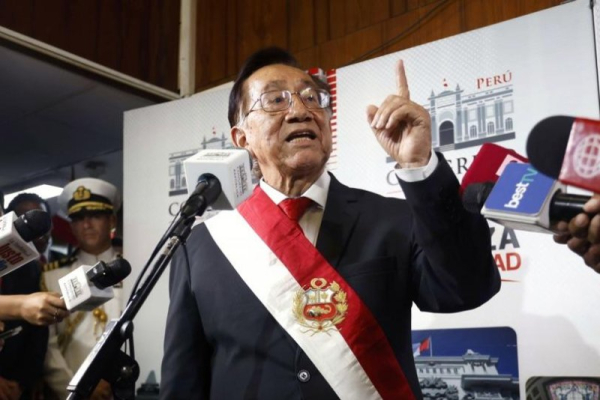
Peru’s new interim president, Jose Maria Balcazar, speaks at a press conference in Lima, Peru, on Wednesday. Peru’s political crisis led to the ouster of its eighth president in nearly a decade. It took a surprising new turn with the appointment of octogenarian congressman Balcazar as interim president, from the Marxist Peru Libre party, with which Pedro Castillo won the presidential elections five years ago. Photo by EPA
Peru’s Congress elected leftist lawmaker Jose Maria Balcazar, 83, as interim president late Wednesday after removing Jose Jeri a day earlier amid corruption allegations.
Lawmakers chose Balcazar in a second round of voting during an extraordinary session convened to fill the vacancy left when Jeri was censured as congressional president. Under Peru’s constitutional succession rules, the head of Congress automatically assumes the presidency on an interim basis.
In the final vote, Balcazar secured 64 votes, while right-wing congresswoman Maria del Carmen Alva received 46, according to RPP Noticias.
Balcazar, now the oldest president in Peru’s history, will remain in office until July 28, when he must transfer power to the winner of the April 12 presidential election.
Peru has experienced significant political instability over the past decade. Six recent presidents have faced removal proceedings or imprisonment.
Analysts frequently point to repeated use of constitutional mechanisms, such as presidential vacancy on grounds of “moral incapacity” and censure votes against congressional leadership — developments that have contributed to a fragile presidency.
Balcazar becomes the fourth president of the 2021-2026 constitutional term that began with electing leftist Pedro Castillo. Castillo was removed the following year after attempting to dissolve Congress.
Dina Boluarte succeeded him but was removed in October 2025 on grounds of moral incapacity. Jeri then assumed the presidency before being ousted after about four months in office.
A lawyer by training, Balcazar served as a magistrate and member of Peru’s Supreme Court before entering Congress in 2021 as a representative of the leftist Peru Libre party, which also backed Castillo’s presidential bid.
During Castillo’s administration, Balcazar emerged as one of his most visible defenders, supporting his government and questioning investigations involving officials close to the executive branch, local outlet Peru21 reported.
Congressional records show Balcazar did not register a vote during the December 2022 proceedings that removed Castillo after his attempted self-coup.
In June 2023, he drew criticism during debate on legislation to prohibit child marriage when he said “early sexual relations” contribute to the “psychological future of women” — comments that sparked political and public backlash.
His rise to the presidency has also renewed attention to past investigations and complaints cited by local media. Infobae reported that Balcazar has faced allegations including suspected judicial misconduct, fraud, identity impersonation and bribery, along with other questions linked to his time as a magistrate and lawmaker.
In his first remarks after being elected president, Balcazar said it is possible to restore democracy and stated that “it is not difficult to govern a country.” He added that “in one month, we can do many things.”
The interim president also addressed the upcoming election, pledging his administration will oversee an orderly process without disputes.
The changes in the presidency do not alter the electoral timetable. In December, the registration period for presidential candidates and congressional lists closed.
Thirty-six presidential candidates and 38 congressional lists were registered, reflecting the country’s high level of political fragmentation. Electoral authorities must now verify the validity of those candidacies.
