

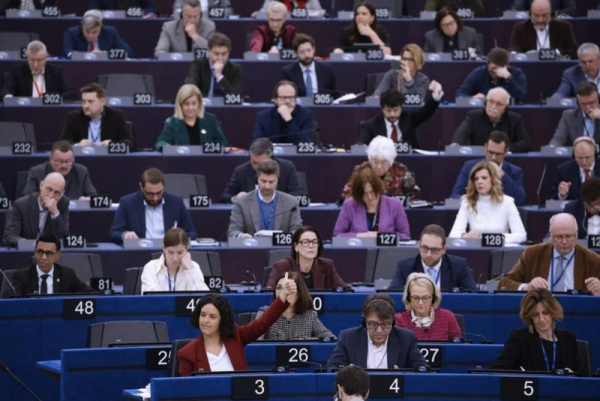
French member of the European Parliament Manon Aubry (lower left), gestures during the vote to refer the Mercosur trade deal case to the Court of Justice of the European Union, Strasbourg, France, on Wednesday. Photo by Yoan Valat/EPA
The governments of Uruguay, Argentina, Paraguay and Brazil are moving forward with their internal ratification processes for the trade agreement between Mercosur and the European Union.
That is occurring despite a decision by the European Parliament to delay final approval and submit the text for legal review to the Court of Justice of the European Union.
The treaty, signed Saturday after more than two decades of negotiations, must be ratified by national legislatures. In South America, governments say that advancing domestic approval is key to maintaining political momentum, even as the European process remains uncertain.
In Europe, the agreement still faces additional legal scrutiny beyond political approval, a step that could delay or even block its application regardless of progress in Mercosur countries.
Uruguayan Foreign Minister Mario Lubetkin said that, barring a scenario of outright blockage in Europe, the agreement’s tangible effects could begin to be felt between 2027 and 2028.
In an interview with Uruguayan daily El País, Lubetkin said the European Parliament’s decision to refer the text to the court could result in a delay of 18 to 24 months. He noted, however, that similar reviews were carried out in the past for agreements with Canada and Singapore, which were ultimately upheld by the court.
Lubetkin acknowledged that the move affects Europe’s credibility as a negotiating partner, but rejected the idea that it signals the cancellation of the deal.
“We cannot come to a standstill,” he said, stressing that Uruguay will continue with its own ratification process.
He added that the focus this year will be on parliamentary approval and technical preparation, while the economic and trade impacts are expected to materialize later.
Argentina has taken a firmer stance in response to the European decision. The government of President Javier Milei plans to submit the agreement to Congress for debate starting Feb. 2 during an extraordinary legislative session, aiming for Argentina to become the first Mercosur country to ratify the treaty.
According to Argentina’s La Nacion newspaper, official sources said the executive branch will not wait for the European court’s ruling and claims to have secured enough votes in both chambers.
Foreign Minister Pablo Quirno reaffirmed Buenos Aires’ support for the agreement after meeting with his Dutch counterpart at the World Economic Forum in Davos. In a message posted on X,
Quirno said the treaty is essential to strengthening competitiveness, attracting investment and consolidating stable rules between the two blocs.
Paraguay is also seeking to move quickly. President Santiago Peña announced that he will submit the agreement to Congress next week, likewise aiming for Paraguay to be the first to ratify it.
Peña said the referral of the text to the European Court of Justice was an anticipated scenario and does not represent a real obstacle. He pointed out that other EU agreements have been applied provisionally for years while legal reviews were resolved.
In Brazil, the government of President Luiz Inácio Lula da Silva also has accelerated internal steps following the European Parliament’s narrow vote in favor of legal review.
Lawmakers believe demonstrating domestic commitment could serve as a political signal to prevent the agreement, negotiated over 26 years, from becoming mired in another prolonged period of uncertainty, Folha de S. Paulo newspaper reported.
Even if Mercosur legislatures approve the treaty, its implementation will ultimately depend on decisions taken by European institutions, a process that could extend for several years.
