

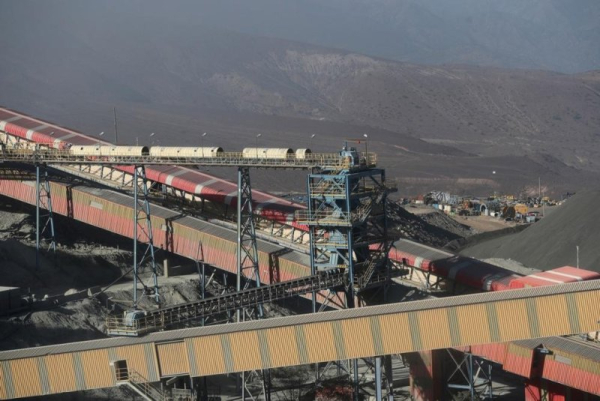
El Teniente mine in Rancagua, south of Santiago, is the largest underground mine in the world. File Photo by Mario Ruiz/EPA
Chile’s mining investment project pipeline for the 2025-2034 period will total $104.55 billion, according to the latest Chilean Copper Commission survey.
The figure represents a 25.7% increase from the previous report and marks the highest investment level recorded in the past 11 years.
The portfolio includes 64 mining projects focused on copper, gold, iron, lithium and industrial minerals. About 41% of the projects are currently under execution, while the rest are at the pre-feasibility stage at 29%, feasibility at 26% and conceptual studies at 4%.
During the presentation of the survey, Chilean Mining Minister Aurora Williams said the investment level shows the country’s mining sector is regaining momentum.
“This projection confirms that Chile remains a key player in the energy transition and in the global supply of strategic minerals,” she said.
Victor Garay, Chilean Copper Commission’s mining market coordinator, told UPI that the 2025-2034 portfolio shows strong growth and a significant increase in total investment. He said it also marks a second consecutive year of expansion and confirms that the investment cycle has regained strength.
Garay said the advance also reflects a strategy aligned with international conditions. He explained that replacement and expansion projects at existing operations dominate the portfolio, an approach that improves the likelihood of execution, facilitates schedule control and reduces operational and startup risks.
“Something very promising is coming for copper at the global level and Chile clearly holds a very privileged position in copper development,” economic analyst Pablo Barberis told UPI. Barberis teaches at Unegocios, the business school of the University of Chile’s Faculty of Economics and Business.
“Chile is the world’s leading power in copper production and commercialization, driven by the growth of electric mobility and the expanding use of copper across companies and households,” he said.
With this level of future investment, Garay said there is a relative improvement in the country’s perception and governance.
“When a country sends signals of institutional certainty, regulatory consistency and technical capacity, its positioning improves among both emerging and developed economies,” he said.
The report showed that 81% of the portfolio is linked to brownfield projects, defined as replacement and expansion initiatives, while greenfield projects account for 19%.
“In an environment of strong competition for capital and higher regulatory demands, companies are prioritizing investments with a higher probability of execution that allow them to sustain production, extend mine life and capture efficiencies using existing infrastructure,” Garay said.
He added that this approach reduces technical and logistical uncertainty, shortens relative timelines and limits exposure to factors that tend to be more complex in new projects, such as lengthy permitting processes, higher territorial conflict and additional infrastructure needs.
At the same time, greenfield projects, those developed from scratch, continue to face a higher risk premium. To regain a stronger role in Chile’s mining landscape, the focus must be on reducing uncertainty related to geological, environmental, economic and political factors.
