

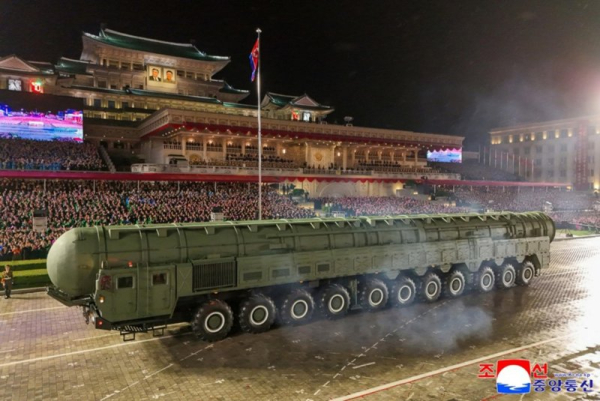
A new intercontinental ballistic missile (ICBM) during a military parade celebrating the 80th founding anniversary of the Workers’ Party of Korea at the Kim Il Sung Square in Pyongyang, North Korea. File. Photo by KCNA / EPA
South Korea and Japan are entering a period of intensified debate over independent nuclear capabilities as confidence in the United States’ security commitment shows signs of strain, according to analysts and a recent report by the Council on Foreign Relations.
In the spring of 2026, Northeast Asia’s security environment is shifting as prolonged instability from the Iran conflict and the U.S. “America First” approach raise questions about the reliability of Washington’s extended deterrence, often referred to as the nuclear umbrella.
The report said both countries are moving beyond civilian nuclear energy and increasingly focusing on “nuclear latency,” or the technical capacity to develop nuclear weapons if necessary.
A key driver behind the debate has been energy security. With disruptions linked to tensions in the Middle East affecting supply routes such as the Strait of Hormuz, South Korea and Japan – which rely heavily on imported oil and liquefied natural gas – face mounting pressure to secure stable energy sources. This has elevated the importance of nuclear power and issues such as uranium supply and enrichment rights.
South Korea previously revised its bilateral nuclear agreement with the United States to allow uranium enrichment for civilian use up to 20%, but experts say additional flexibility may be needed to support future technologies such as nuclear-powered submarines and small modular reactors.
Japan is widely viewed as having a more advanced nuclear infrastructure. It holds about 45 tons of plutonium and possesses the technical capability to produce nuclear weapons within months if it chooses to do so, analysts say. Experts describe Japan as maintaining a state of “latent” nuclear capability – having the materials and technology while refraining from weaponization.
Public opinion in South Korea has shifted alongside these developments. A survey by the Asan Institute for Policy Studies found that about 76% of respondents support developing nuclear weapons domestically, reflecting growing concern about national security.
Doubts about U.S. extended deterrence have also increased. Recent remarks by President Donald Trump emphasizing burden-sharing among allies have contributed to perceptions that U.S. protection may be conditional.
A former senior military official said U.S. forces are being stretched by conflicts elsewhere, including the Middle East, raising concerns about reduced military presence around the Korean Peninsula.
Experts say South Korea and Japan are unlikely to pursue immediate nuclear armament due to the risk of international sanctions and diplomatic isolation. Instead, they are expected to focus on strengthening nuclear-related capabilities to enhance deterrence while avoiding direct violations of international norms.
John Mearsheimer, a professor at the University of Chicago, has argued that independent nuclear capabilities for both countries may be a logical outcome if U.S. strategic attention continues to shift away from Asia.
At the same time, such moves could provoke strong responses from neighboring countries. China has warned of possible economic retaliation and military countermeasures, while North Korea has accused South Korea of moving toward becoming a “quasi-nuclear state.”
Analysts say the possibility of a broader “nuclear domino” effect in Northeast Asia is increasingly being discussed as regional uncertainty deepens.
— Reported by Asia Today; translated by UPI
© Asia Today. Unauthorized reproduction or redistribution prohibited.
Original Korean report: https://www.asiatoday.co.kr/kn/view.php?key=20260412010003441
