

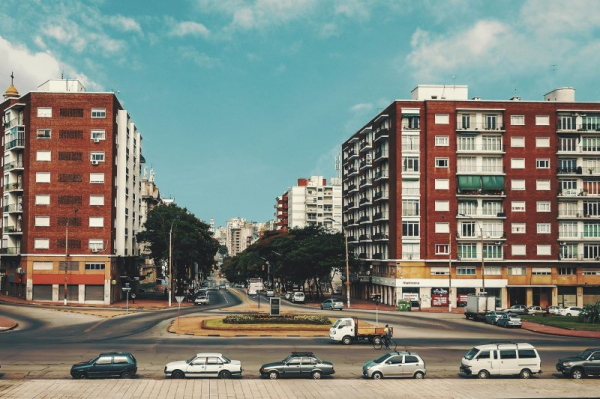
A Re/Max expert says Montevideo tops the ranking because of its economic stability and limited housing supply, especially in high-demand neighborhoods Photo by JohnNico/Pixabay
Montevideo has become the most expensive city in Latin America to buy an apartment, according to the latest Latin American Real Estate Survey, conducted by the Argentinian Torcuato Di Tella University Center for Financial Research and the property platform Zonaprop.
The study, based on prices published in September, found that the price in the Uruguayan capital reached $3,209 per square meter, surpassing other major cities in the region. At that rate, a 60-square-meter, two-bedroom apartment would sell for $192, 540.
Yuval Ben Haym, regional director of Re/Max, told UPI that Montevideo tops the ranking because of its economic stability and limited housing supply, especially in high-demand neighborhoods such as Pocitos, Carrasco, Punta Carretas and Puerto Buceo.
He said the city attracts regional capital in dollars and has a limited stock of properties in premium areas, which drives up the price per square meter.
“That combination of stability and high-demand positions Montevideo as one of the most expensive and attractive cities for investment in Latin America,” he said.
Mexico City ranked second at $2,909 per square meter, followed by Monterrey at $2,787 and Guadalajara at $2,717.
A recent study by Propiedades.com, which analyzed changes in sale and rental prices in Mexico over the past 10 years, also found that these cities — along with Mérida — report the highest values in the country.
“The data show a transformation in certain urban areas that, driven by investment and the arrival of new residents, shifted their market value,” Juan David Vargas, general manager of the real estate marketplace, said in a press release.
The high price per square meter in Mexican cities is also driven by several factors. Urban land has become more expensive because of population pressure and the limited availability of well-located lots, especially in central areas and high-demand neighborhoods.
After the pandemic, rising construction material costs and inflation hit the sector hard, and those increases are reflected in final prices.
Buenos Aires ranks fifth, with an average price of $2,622 per square meter.
Germán Gómez Picasso, founder of Reporte Inmobiliario, told UPI that several factors are pushing prices higher. One is stronger demand. “The number of sales today exceeds historic averages,” he said.
Sao Paulo, Rio de Janeiro, Lima and Panama City occupied the next positions in the ranking.
For Santiago, Chile, Yuval Ben Haym said that this semester’s RIAL excluded the Chilean capital because the company that provides the data — Grupo QuintoAndar — does not operate there.
Even so, he said that if Re/Max sales in Santiago were evaluated under the same criteria, the average price would be about $3,000 per square meter. That figure would place Santiago second in the region, behind Montevideo and above Mexico City.
The RIAL survey, conducted twice a year, uses prices published during the last week of March and September as its reference. The information comes from classified listings on platforms operated by Grupo QuintoAndar.
To ensure precise comparisons, the report selected neighborhoods with similar profiles in each city and considered only the asking prices listed by sellers.
On how to interpret the results, Gómez Picasso stressed that each market has its own characteristics. “It’s difficult to draw a direct relationship that explains why prices are higher in one place than another,” he said.
He said the factors that influence prices include the availability of mortgage credit, construction costs, local demand and purchasing power. “The price per square meter can be five to seven times higher in one city than another without following a common pattern,” he added.
