

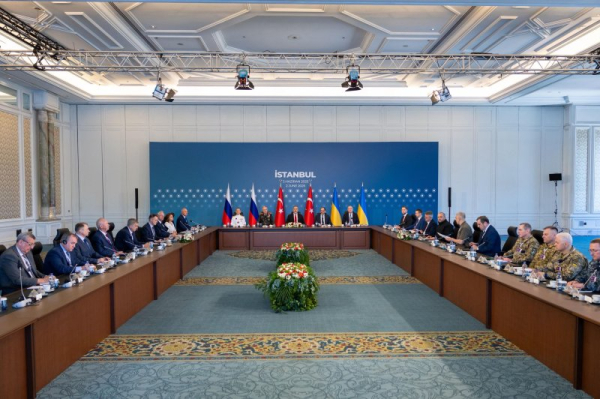
Turkish Foreign Minister Hakan Fidan (C) opened a second round of peace talks on Monday between Ukraine and Russia in Istanbul, Turkey. Photo by Murat Gok/Turkish Foreign Ministry/EPA-EFE
A second round of Ukraine-Russia peace negotiations got underway in Turkey on Monday in an effort to find a way forward in ending more than three years of war triggered by Russia’s full-scale invasion of its western neighbor.
The delegations — minus Ukrainian President Volodymyr Zelensky and Russian President Vladimir Putin — gathered in Istanbul a little more than two weeks after an initial round produced little progress, despite pressure from the United States to deliver a deal or a cease-fire at the minimum.
Opening the negotiations at the Ciragan Palace, Turkish Foreign Minister Hakan Fidan said he hoped they would be “fruitful” and that there would be “concrete” developments that would benefit both countries.
Ahead of the talks, the Trump administration made it known that it expected more this time around than the prisoner swap agreement reached by the two sides on May 16. Those talks broke up after less than two hours.
The U.S. State Department said Secretary of State Marco Rubio spoke on the phone Sunday with his Russian counterpart, Sergei Lavrov, at Moscow’s request, saying that Rubio “reiterated President Trump’s call for continued direct talks between Russia and Ukraine to achieve a lasting peace.”
In a post on X, Russia’s Foreign Ministry said simply that the two ministers had held a “discussion focused on the ongoing crisis surrounding Ukraine.”
However, the BBC reported that expectations for the U.S.-brokered talks were not high, due to the gap between the two sides on key points of difference.
The main one is Russia’s demand Ukraine withdraw its forces fighting Russian forces in four of its regions — Donetsk, Luhansk, Zaporizhzhia and Kherson — which Russia annexed in 2022 but only partially controls.
Ukraine submitted a peace terms document ahead of the meeting, while Moscow said it had submitted a “memorandum regarding a potential future peace treaty” as promised during Putin’s May 19 call with Trump, but insisted it would not share it with Kyiv until today’s meeting.
Russia’s proposal calls for a guarantee of no further NATO expansion to the east, lifting of some Western sanctions and a resolution to the some $300 billion of Russian assets frozen in Europe, and security guarantees for Russian-speaking Ukrainians.
Momentum to impose new sanctions has been growing on both sides of the Atlantic with the European Union poised to impose an 18th set of Russia sanctions ensuring the Nord Stream 1 and 2 gas pipelines remain mothballed, targeting the Russian shadow shipping fleet and financial institutions and slashing the crude oil price cap.
European Commission President Ursula von der Leyen met in Berlin on Monday with U.S. Senator Lindsay Graham, R-S.C., who will introduce what he termed a “bone breaking” sanctions bill into the Senate next week.
In a news release, Von der Leyen said step the EU was preparing, taken together with Graham’s U.S. measures, “would sharply increase the joint impact of our sanctions.”
Graham’s secondary sanctions legislation, which would also have to clear the House, would impose a 500% tariff on imports from countries that purchase Russian products, including gas, oil and uranium.
Graham said he would work to build backing among both Republican and Democratic colleagues “for tools that would help President Trump get Putin to the peace table.”
“These sanctions would do that,” he added.
