

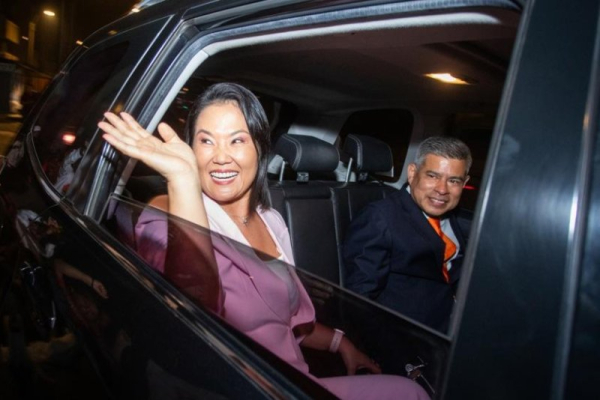
Keiko Fujimori, presidential candidate for the Fuerza Popular party in Peru, greets supporters along with her vice-presidential running mate Luis Galarreta after the presidential debate in Lima on March 25. Photo by Renato Pajuelo/EPA
Peru on Monday closed its election campaign ahead of Sunday’s general vote, with Keiko Fujimori leading opinion polls in a fragmented race marked by deep voter divisions between the 35 candidates.
Surveys published Sunday by polling firms Ipsos and Datum show Fujimori, leader of the Fuerza Popular party, with between 13% and 13.7% support, Infobae reported. Despite her lead, the figures reflect a highly competitive field with no clear frontrunner.
In her final campaign appearances, Fujimori focused on “order and security,” promoting proposals such as agricultural assistance programs and school support.
She also urged caution among her supporters, noting that her place in a potential runoff is not guaranteed due to the narrow margin separating her from her rivals, local outlet Ecos Huacho reported.
One of the biggest surprises in the last week has been the rise of Carlos Álvarez, candidate for País para Todos. A well-known comedian and impersonator, Álvarez has capitalized on public dissatisfaction with traditional political elites, positioning himself as an outsider competing closely for second place with about 9% support.
His campaign, centered on tough-on-crime policies and mandatory civic education, has resonated with voters seeking new leadership, in some polls surpassing established candidates.
During campaign events, Álvarez said that if elected, he would invite El Salvador President Nayib Bukele to help implement his security model, Latina Noticias reported.
Meanwhile, the candidacy of Rafael López Aliaga of the Renovación Popular party has shown a downward trend in the final stretch. The current mayor of Lima, who took a leave of absence to run, began March as a leading contender, but has since seen support fall to between 8% and 10%.
López Aliaga has questioned the credibility of pollsters while reinforcing campaign promises, including expanding the city’s “Hospitales de la Solidaridad,” a network of low-cost public health services, during his closing rally in the northern region of Piura.
Undecided voters and blank or invalid ballots are expected to play a decisive role. About 13.9% of voters remain undecided, while nearly 28% say they plan to cast a blank or spoiled ballot, surpassing the support of any individual candidate. This large share of votes will strongly influence who advances to a likely runoff in June.
Analysts warn the next president could take office with weak legitimacy, facing a fragmented bicameral Congress that may deepen political instability and legislative gridlock.
Political scientist Alberto Vergara Paniagua told RPP Noticias that Peru’s prolonged instability is unlikely to be resolved by the election, describing it as part of a broader “cycle of chronic instability.”
Vergara said the country’s political system operates erratically and is driven by short-term interests.
Over the past decade, Peru has faced an unprecedented institutional crisis, with eight presidents in 10 years. The situation has been compounded by constant clashes between the executive branch and a fragmented Congress that has repeatedly used the constitutional mechanism of “moral incapacity” to remove presidents.
The broader political landscape remains highly fragile. Unlike previous elections, there is no clear ideological alignment or coattail effect, and public sentiment is dominated by rejection, with 81% of voters saying they do not feel represented by any political group.
