

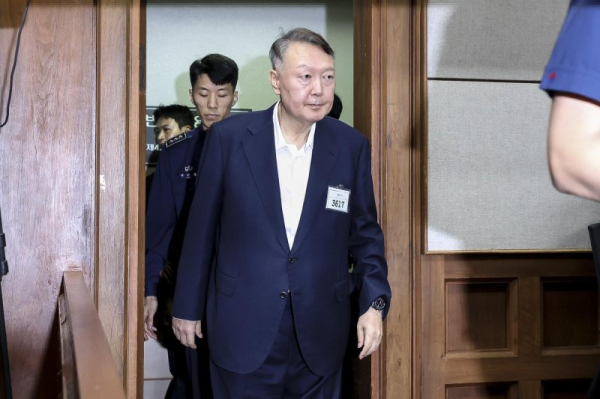
Former President Yoon Suk Yeol enters a courtroom at the Seoul Central District Court in Seoul, South Korea, 26 September 2025. Photo by EPA/YONHAP
A South Korean military internal investigation found the government decided in late 2023 to resume leaflet drops targeting North Korea after a yearslong suspension and that the operation was tightly controlled through secure communications with instructions to leave no paper trail, according to findings released by an opposition lawmaker.
Rep. Choo Mi-ae of the Democratic Party, a member of the National Assembly’s Legislation and Judiciary Committee, disclosed on Wednesday the Defense Ministry’s investigation results into personnel involved in the chain of command, including the Armed Forces Psychological Warfare Unit and the Joint Chiefs of Staff.
According to the findings provided by Choo’s office, the decision to restart leaflet operations was made by the National Security Council during the administration of former President Yoon Suk Yeol after leaflet distribution had been halted since July 2017.
The report said that after South Korea’s Constitutional Court ruled the anti-leaflet law unconstitutional in September 2023, the NSC convened a standing committee meeting to evaluate the Sept. 19 inter-Korean military agreement and discuss countermeasures. The investigation found the 34th NSC meeting, attended by then Defense Minister Shin Won-sik, Unification Minister Kim Young-ho and National Intelligence Service Director Kim Kyu-hyun, discussed leaflet distribution to North Korea.
The Defense Ministry said the meeting results are preserved as presidential records and that it could not confirm specific details such as the rationale for resuming the operation, the report said.
The investigation said Shin later issued a verbal order on Nov. 8, 2023, to restart the leaflet mission. The order was relayed through the Joint Chiefs of Staff to the Psychological Warfare Unit.
The Psychological Warfare Unit carried out 23 leaflet drops targeting 35 locations from Feb. 18 to Nov. 15 last year, including major cities such as Pyongyang and Wonsan and military units, the report said.
All reports and approvals were conducted through secure phones, according to the findings. Units involved in the operation deleted records tied to leaflet missions during routine monthly cyber and security diagnostics, and the Joint Chiefs of Staff instructed personnel to leave no documents related to the operation, the report said.
The investigation also said the defense minister’s office encouraged the effort through incentive payments to the Psychological Warfare Unit while operations were underway.
It said Shin provided 2 million won ($1,500) in incentive funds during an in-person briefing on loudspeaker operations against North Korea on July 26 last year and that his successor, then Defense Minister Kim Yong-hyun, provided 3 million won ($2,200) in incentive funds during an Oct. 23 briefing on psychological operations, including leaflet drops.
The Defense Special Investigation Headquarters plans to further examine the background of the decision to resume leaflet operations, any alleged illegal acts tied to the missions and whether the effort was connected to a declaration of martial law, based on the Defense Ministry’s findings, the report said.
The special prosecutor investigating the alleged insurrection case believes Yoon began preparing in earnest for martial law starting in October 2023, around the time the decision was made to resume leaflet operations, the report said. It said key posts were filled in October and November 2023 promotions, including Army Chief of Staff Park An-soo, Special Warfare Commander Kwak Jong-geun, Counterintelligence Commander Yeo In-hyeong and Capital Defense Commander Lee Jin-woo.
The special prosecutor’s office alleged Yoon sought to provoke a North Korean military response through “abnormal” military operations to justify emergency martial law and last month indicted Yoon and Kim on insurrection-related charges, the report said.
– Reported by Asia Today; translated by UPI
© Asia Today. Unauthorized reproduction or redistribution prohibited.
