

Qatari Minister of State for Foreign Affairs Mohammed bin Abdulaziz Al-Khulaifi announced on Monday a comprehensive aid package for Lebanon, including hundreds of millions of dollars for its ailing electricity sector and support for the return of Syrian refugees to their country — a move that could open the way for investments from other Gulf countries.
“It is time for Lebanon to recover and move forward on a path of progress and development,” said Al-Khulaifi after meeting with Lebanon’s top officials in Beirut.
He told reporters after talks with Prime Minister Nawaf Salam, that the comprehensive development and humanitarian aid package includes a $40 million grant to support Lebanon’s electricity sector, alongside a $360 million economic project benefiting approximately 1.5 million electricity subscribers nationwide.
President of Lebanon Meets Minister of State at Ministry of Foreign Affairs @Dr_Al_Khulaifi #MOFAQatar pic.twitter.com/PQNgxkmITJ— Ministry of Foreign Affairs – Qatar (@MofaQatar_EN) January 26, 2026
Lebanese citizens are still suffering from power blackouts that disrupt daily life and force heavy reliance on costly generators. These problems have been caused by years of mismanagement, underfunding, and the 2019 economic collapse, which left the electricity company both indebted and unreliable.
Al-Khulaifi said Qatar will fund 185 scholarships over three years for Lebanese youth, while 4,400 children and young people in conflict-affected areas will benefit from a new “Sport for Development and Peace” initiative aimed at “reducing violence and strengthening social resilience.”
He said his country will also finance the reconstruction of a public hospital in Beirut, which was destroyed in the 2020 Beirut port explosion, while additional health-related projects are still under review.
Moreover, Qatar will support the return of 100,000 Syrian refugees from Lebanon, allocating $20 million for housing, food, and medical assistance for the returnees.
Around half a million of Lebanon’s 1.5 million Syrian refugees have returned to Syria in 2025, according to Lebanese Social Affairs Minister Haneen Sayed.
Al-Khulaifi reaffirmed his country’s continued support for the Lebanese Army, describing it as “a key national institution” that forms the basis for Lebanon’s security and stability.
Over the past four years, Qatar has provided financial and military support for the Lebanese Army, including funding soldiers’ salaries, fuel supplies, and military vehicles.
The Qatari minister pledged unlimited support for Lebanon, expressing hope that the country will be able to attract investments from other Gulf states.
International and Arab funding support for Lebanon has been conditioned on the disarmament of Hezbollah and the introduction of much-needed reforms.
Al-Khulaifi, moreover, emphasized Qatar’s political support, referring to ongoing dialogue with the United States to help coordinate international efforts for implementing the November 2027 cease-fire agreement that was brokered by Washington and Paris to end the war between Israel and Hezbollah.
Lebanese President Joseph Aoun called during his meeting with the Qatari official for exerting pressure on Israel to abide by the truce accord, for it continues to strike villages in southern and eastern Lebanon, causing more destruction and displacement.
Israel has refused to withdraw from five strategic positions it still occupies in southern Lebanon since it pulled out troops in line with the cease-fire accord. It also refrained from releasing Lebanese prisoners detained during the war and prevented displaced residents from returning to their border villages that has largely turned to ruin.
Hezbollah, which was severely weakened during the war that erupted after it opened a support front for Gaza on Oct. 8, 2023, has kept a low profile and refrained from retaliating.
While quietly attempting to reorganize its ranks and secure new channels for rearming and funding, Hezbollah refuses to lay down arms south of the Litani River as long as Israel does not abide by the truce accord.
Israel, which has been escalating its attacks on alleged Hezbollah positions and operatives, has threatened to launch a wide-scale war against Lebanon to pressure the disarmament of the militant group.
The week in photos: Protestors, NFL, premieres
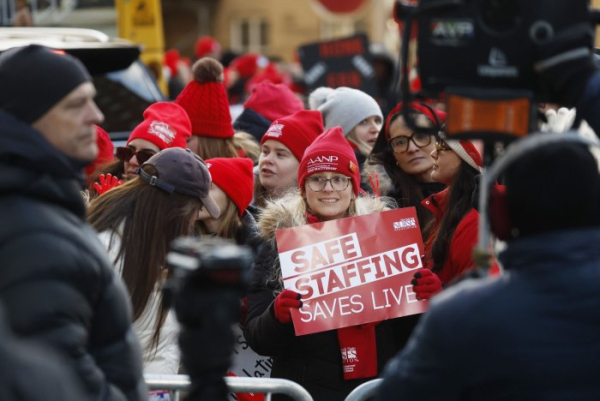
Picketers hold signs outside at the entrance to Mount Sinai Hospital on Monday in New York City. Nearly 15,000 nurses across New York City are now on strike after no agreement was reached ahead of the deadline for contract negotiations. It is the largest nurses’ strike in NYC’s history. The hospital locations impacted by the strike include Mount Sinai Hospital, Mount Sinai Morningside, Mount Sinai West, Montefiore Hospital and New York Presbyterian Hospital. Photo by John Angelillo/UPI | License Photo
