

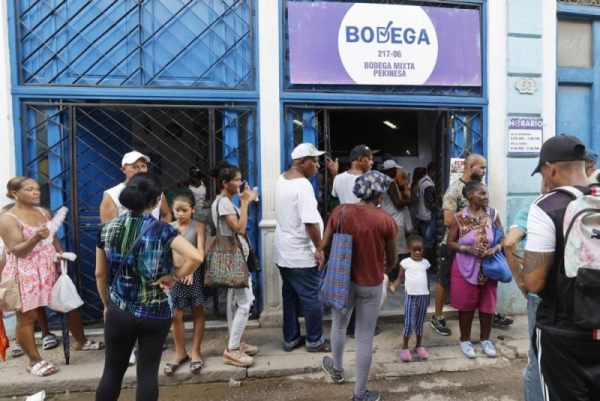
People line up to shop at a state-owned store in Havana in September 2025, before widespread food shortages started. File Photo by ERnesto Mastrascusa/EPA
A television report in Mexico said food products sent as humanitarian aid to Cuba are being sold in stores instead of reaching the population, an accusation the Cuban government rejected as false.
The investigation, broadcast by Mexican network TV Azteca, re[ported that products sent as part of Mexican aid packages appeared for sale in establishments in Havana and other provinces that sell exclusively in dollars and are linked to commercial networks controlled by the state and military apparatus.
According to the report, some of these foods were intended to be distributed free among the population amid a food crisis that affects the island.
Among the products identified is the so-called “frijol del bienestar,” a packaged bean concoction included in assistance shipments from the Mexican government. The report said it is available through wholesale distributors and foreign-currency stores.
Interviews made by the network confirmed that the free aid did not reach citizens.
“Nothing has arrived here. Everything is the same. We are going through difficult times; we are surviving,” one of the residents interviewed said.
Sources cited in the investigation indicated that a 66-pound sack of beans is offered for about $43, which is equivalent to more than $1 for each 2.2-pound bag.
In another case, 1.1 pounds of Mexican beans was sold for $2.97 in a store linked to TRD Caribe, a commercial network historically associated with Cuba’s Revolutionary Armed Forces.
Residents also reported the appearance of other Mexican products, such as toilet paper, in establishments that previously had shortages of merchandise.
“The foreign-currency collection stores, which are military, used to be empty and now they are full. You can see that donations from several countries have arrived,” another resident said.
Another Cuban interviewed said the practice is widely known among the population.
“They haven’t given anything here. It’s an open secret that they sell everything in the TRD stores of the FAR and the Council of State, and everything is in dollars.”
However, Cuba’s ambassador to Mexico, Eugenio Martínez Enríquez, rejected the accusations and accused TV Azteca of spreading disinformation.
In a statement on his Facebook page, the diplomat said the humanitarian aid sent by the Mexican government and citizens of Mexico is distributed transparently among the most vulnerable sectors of the Cuban population.
“The generous aid to the Cuban people offered by the government of Mexico and thousands of Mexicans is being attempted to be tarnished by TV Azteca,” Martínez Enríquez said.
“Without providing evidence, because none exists, the outlet accuses the Cuban authorities of selling the aid sent.”
The ambassador added that some Mexican products sold in stores on the island correspond to imports made through commercial contracts between companies in both countries.
“In 2025, Mexico exported food industry products to Cuba for several tens of millions of dollars,” he said. “Those products, of course, are sold in stores.”
The diplomat also linked the accusations to the regional political context and said U.S. sanctions against Cuba have severely affected the country’s access to fuel, as well as production and basic services.
In recent years Mexico has sent several shipments of humanitarian aid to Cuba amid shortages of food, fuel and medicine affecting the island during a prolonged economic crisis.
