

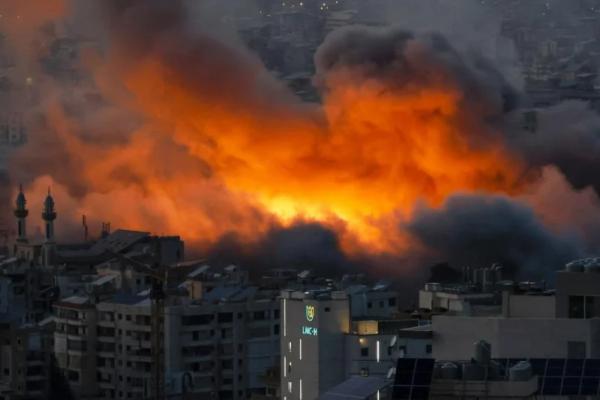
Smoke and flames rise after an Israeli airstrike on Dahieh, a predominantly Shia Muslim suburb in the south of Beirut, Lebanon, on Friday. Photo by Wael Hamzeh/EPA
Lebanese Prime Minister Nawaf Salam warned Friday of a “humanitarian disaster” after Israel ordered mass evacuations in south Lebanon and Beirut’s southern suburbs, saying the country has been dragged into a devastating war it did not choose.
Speaking during a meeting with Arab and foreign ambassadors in Beirut, Salam warned that Lebanon was facing “a dangerous and trying moment” after Iran-backed Hezbollah resumed fighting, triggering massive Israeli airstrikes and deeper incursions into southern Lebanon.
“Our country has been drawn into a devastating war that we did not seek and did not choose. It was a war imposed upon us,” he said, urging efforts to prevent Lebanon from plunging into further violence and chaos.
After nearly 15 months of restraint along the Lebanon-Israel border, Hezbollah fired missiles and drones into northern Israel early Monday, marking a major escalation less than two days after Iran’s Supreme Leader, Ali Khamenei, was killed in a strike on his bunker in Tehran at the start of the U.S.-led war on Iran.
The group’s action — seen as support for Iran in the war — sparked intensified Israeli strikes on Beirut’s southern suburbs and other areas, killing at least 217 people and wounding 798.
Israel then ordered residents of southern Lebanon, parts of the eastern Bekaa Valley and the southern suburbs of Beirut — Hezbollah’s main stronghold — to leave their homes and villages, causing massive displacement.
“The situation is grave…. A humanitarian disaster is looming,” Salam warned, saying that the consequences of this displacement “may well be unprecedented.”
According to Ravina Shamdasani, spokesperson for the U.N. High Commissioner for Human Rights, hundreds of thousands of people have been impacted by Israel’s displacement orders, which targeted 100 towns and villages in southern Lebanon and nearly all of Beirut’s southern suburbs.
In a statement, Shamdasani questioned “the effectiveness” of Israel’s evacuation orders, which risk amounting to “prohibited forced displacement.”
She said Israel’s military ground incursions into southern Lebanon, along with blanket displacement orders and continued airstrikes, “are bringing more misery and suffering to an already weary civilian population.”
Salam said his government’s priority was to stop the war through diplomatic efforts to protect lives and prevent further destruction, reiterating its readiness to “resume all necessary negotiations.”
French President Emmanuel Macron, who led the diplomatic efforts, called Thursday for Hezbollah to immediately cease its attacks against Israel and for Israel to refrain from a ground offensive, with both sides returning to the Nov. 27, 2024, cease-fire agreement.
While Hezbollah pledged to continue resisting, Israel is demanding its complete disarmament and for the Lebanese Army to seize its positions and weapons.
Salam’s government adopted bold measures against Hezbollah, declaring its military and security activities “unlawful” and ordering the arrest and deportation of any members of Iran’s Revolutionary Guards present in Lebanon.
Meanwhile, Israel stepped up airstrikes on Lebanon, conducting 21 raids on Beirut’s southern suburbs since Thursday’s evacuation orders, killing and injuring several people, destroying high-rise buildings and causing extensive damage.
A strike near the Iranian Embassy in Beirut’s Beirut Hassan neighborhood killed one person, the Lebanese Health Ministry said.
Five people were killed and seven wounded in a strike on a commercial center in the southern port city of Sidon, which the Israeli Army said targeted the office of Issam Khashan, head of Palestinian Hamas’s fundraising apparatus in Lebanon.
More Israeli strikes were reported on various areas in southern and eastern Lebanon, inflicting more casualties and damage.
Hezbollah announced that its fighters launched missiles and drones at several Israeli military positions and settlements in northern Israel, saying in a statement that its fighters will never drop their weapons.
The Israeli Army said eight of its soldiers were wounded, including four seriously, by a rocket strike near the Lebanon border, according to the Israeli English-language news site Ynet.
