

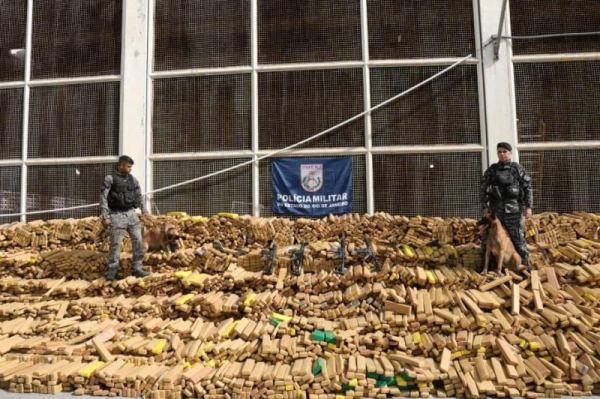
Rio de Janeiro’s Military Police reported the seizure of approximately 48 tons of marijuana in the Nova Holanda community, in Complexo da Maré. Photo courtesy of Governo do RJ/X
Rio de Janeiro’s Military Police reported the seizure of approximately 48 tons of marijuana in the Nova Holanda community, in Complexo da Maré, following an operation that concluded April 8, 2026, in what authorities described as the largest drug bust in Brazil’s history.
According to official statements released by the force, the shipment was hidden inside a bunker-like structure on a rooftop and was discovered during a large-scale operation involving more than 250 officers.
The deployment included support from the Battalion of Police Dogs, whose detection teams played a key role in identifying the hidden cache.
#GovRJ realiza maior apreensão de drogas do Brasil na Maré
Operação da @PMERJ mobilizou mais de 250 agentes e localizou bunker do tráfico com mais de 48 toneladas de entorpecentes.
Principal objetivo da ação era reprimir roubos de veículos de passeio e de cargas na região. pic.twitter.com/GOONpm7r60— Governo do RJ (@GovRJ) April 8, 2026
During the operation, officers also seized five rifles and four pistols and recovered 26 stolen vehicles, including cars and motorcycles. Authorities estimated the value of the drugs at about $10 million, representing a significant financial loss for criminal organizations operating in the area.
The discovery was made possible through the work of detection dogs trained to locate weapons and narcotics. One of the dogs, identified as Hulck, a Belgian Malinois, showed a behavioral change that alerted officers to the presence of hidden substances within the structure.
The seizure surpasses Brazil’s previous record, when 36.5 tons of marijuana were confiscated in the state of Mato Grosso do Sul in 2021, according to data cited in the police report.
The operation took place in Complexo da Maré, a cluster of favelas in northern Rio de Janeiro considered strategic for drug and arms trafficking. Authorities said the scale of the seizure underscores the area’s relevance within trafficking routes in the country.
Rio de Janeiro’s former state governor Cláudio Castro highlighted the outcome of the operation and linked the volume of drugs seized to the logistical capacity of criminal groups.
“This shows the level of audacity of these factions,” Castro wrote on social media. “It also demonstrates why treating public security as a priority has never been a political choice, but a real necessity.”
Vejam o tamanho da estrutura que o crime organizado montou dentro da Maré.
A Polícia Militar fez uma apreensão histórica: 48 toneladas de drogas, a maior do Brasil, além de fuzis, pistolas e veículos recuperados. pic.twitter.com/Ss33XyohKF— Cláudio Castro (@claudiocastroRJ) April 8, 2026
In a separate post, Castro said the state faces increasingly complex criminal structures.
“Rio has moved closer to narco-terrorism,” he wrote. “And I know, from experience, that we can no longer respond to this with weakness.”
