


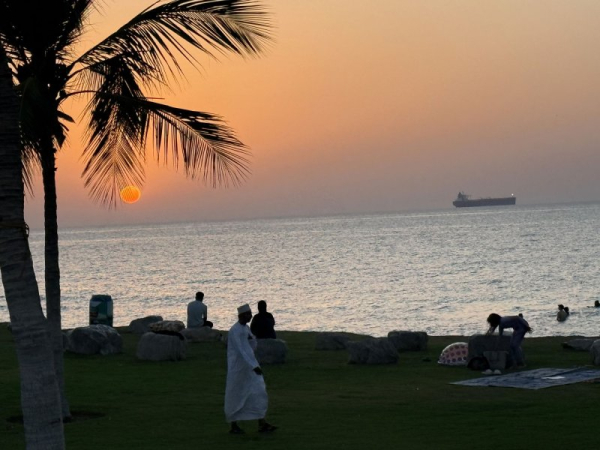
People enjoy the beach as a vessel is seen waiting to cross the Strait of Hormuz in the Arabian Sea off Muscat, Oman, Tuesday, May 12. U.S. Secretary of State Marco Rubio said Tuesday while in India that the strait will be reopened. File Photo by Ismael Mohamad/UPI | License Photo
The Strait of Hormuz will be reopened “one way or the other,” U.S. Secretary of State Marco Rubio warned Tuesday amid uncertainty over ongoing negotiations between the two countries after the United States attacked Iran hours earlier.
The U.S. military conducted what it called “self-defense” strikes in southern Iran on Monday night as Iranian negotiators were in Doha discussing a potential agreement aimed at ending the U.S.-Iran war.
Responding to reporters’ questions about the effect the attacks may have on the already-fragile talks, Rubio suggested that Iran must remove restrictions from the vital energy trade route or risk further U.S. military action.
“Well, the straits have to be open. They’re going to be one way or the other. So they need to be open,” he said.
Tehran has restricted access to the strait since the United States and Israel attacked Iran on Feb. 28, igniting the war. The United States retaliated with a maritime blockade of Iranian ports, cutting it off from sea-based trade as Iran’s restrictions have seen gas prices steadily climb.
The United States and Iran have been conducting on-again, off-again indirect negotiations since a tenuous cease-fire was announced mid-April.
Over the weekend while in India for talks with the Modi government, Rubio projected confidence in the talks, stating Sunday that President Donald Trump might have an announcement, before hours later pulling back, tempering expectations by stating an agreement was “still a work in progress.”
The United States is seeking an agreement under which Iran would lift restrictions on navigation through the Strait of Hormuz. Talks would then enter the second phase focused on ending the war and preventing Iran from acquiring a nuclear weapon.
At Jaipur International Airport on the final day of his four-day trip to India, Rubio said that Trump is “going to make a good deal or no deal” will be made.
“So on that, everyone should be assured. But that may take a little while, I mean, a few more days,” he said.
He also criticized Iran for allegedly running a toll on the strait, which Iran has denied.
“I mean, there’s no country in the world that’s in favor of a tolling system except the regime in Iran,” he said.
“So, that’s not acceptable. That cannot happen. The straits need to be open, unimpeded, without tolls. And obviously that needs to happen immediately as soon as anything’s agreed to.”
Iranian Foreign Ministry spokesperson Esmaeil Baqaei said Monday that Iran charges fees to cover costs associated with navigational services and environmental protection measures, which he said should not be considered a toll, Iran’s official Islamic Republic News Agency reported.
He said Iran was working to establish protocols with Oman.
Iranian officials on Tuesday appeared to be further cooling expectations that any agreement was on the horizon.
Ebrahim Azizi, head of Iran’s Parliament’s National Security and Foreign Policy Committee, outlined several mandatory confidence-building measures that the United States must implement before an agreement can be made, the semi-official Mehr News Agency reported.
The demands included accepting Iran’s control of the strait, lifting oil sanctions, ending the U.S. blockade of Iranian ports and ending all fronts of the war, including Lebanon, where Israel launched attacks on Monday. The measures broadly mirror demands Iran has previously raised, minus Tehran’s earlier demand that the United States pay damages for the war.
