

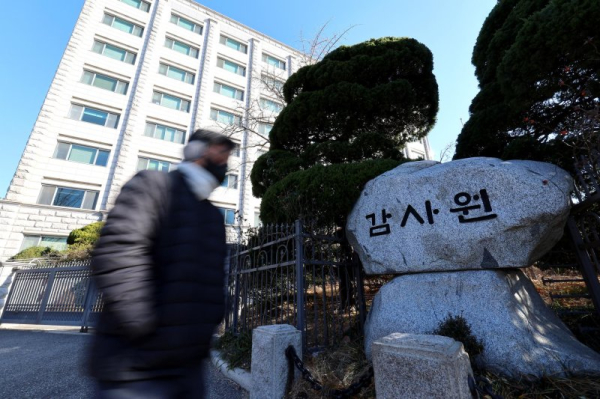
A pedestrian walks past the Board of Audit and Inspection in Seoul on Dec. 3, 2025. Photo by Yonhap News Agency
South Korea’s Board of Audit and Inspection said it has revised internal rules to end what it calls “policy audits,” meaning it will no longer review major government policy decisions unless there are allegations of illegal acts or corruption.
The audit agency said Wednesday it implemented revised “Audit Affairs Processing Rules” on Dec. 12 after the Board of Audit and Inspection Committee approved the changes at a Dec. 3 meeting.
Under the revision, audits will exclude areas such as factual judgments used as the basis for policy decisions, errors in data or information, the appropriateness of means used to achieve policy goals, the legality of the policy decision process and procedural compliance, according to the agency.
The Board said it has narrowed the scope of audit findings to illegal and corrupt acts where corrective action is essential. It said it will focus on its core duties of accounting audits and duty inspections under the Constitution and the Board of Audit and Inspection Act, while seeking to avoid controversy over audits that could dampen public-sector morale.
Some critics said the changes could weaken oversight by limiting scrutiny of misjudgments or distorted data that may not rise to criminality but can still result in major financial losses or social costs.
An official familiar with Board operations was quoted as saying policy quality and accountability improve when reviews of rationality and validity accompany legality, and that audits can serve as an institutional safeguard rather than an obstacle to implementation.
The rule change came about five months after President Lee Jae-myung said “policy audits” can reduce public officials’ motivation, according to the report. Presidential Chief of Staff Kang Hoon-sik also publicly discussed plans last month to abolish policy audits, the report said.
The article contrasted the current approach with past cases cited as examples of the Board maintaining independence, including scrutiny of the Yulgok Project, written investigations of former Presidents Chun Doo-hwan and Roh Tae-woo related to allegations tied to the Peace Dam, and an audit into the Haengdamdo development corruption case during the Roh Moo-hyun administration.
An audit agency official said the intent is to treat policy decisions, which can involve political value judgments, with greater caution, while continuing to punish corruption and misconduct in implementation and to conduct audits aimed at improving performance and efficiency.
– Reported by Asia Today; translated by UPI.
© Asia Today. Unauthorized reproduction or redistribution prohibited.
