

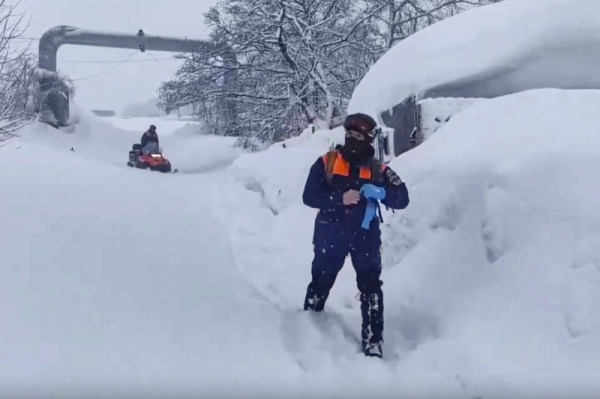
A screen grab from a video shows Russian emergency servicemen working during heavy snowfall in Petropavlovsk-Kamchatskiy, Kamchatka Krai, Russia, on Tuesday. Photo courtesy Russian Ministry of Emergencies for Kamchatka Krai/EPA
Feet of snow buried the town of Petropavlovsk-Kamchatsky, Kamchatka, in Russia’s Far East, during the middle of last week.
Two people were killed by snow falling from rooftops. The Kamchatka Peninsula was also the location of a major earthquake and tsunami last year.
The town was brought to a standstill after the snow, according to The Moscow Times, which reported that snowdrifts reached the second floor of some buildings and blocked their entrances. Cars were also completely buried by snow, making some difficult to find.
“The heavy snow was the result of a powerful storm lifting into the Sea of Okhotsk, which resulted in heavy snow over the southern Kamchatka Peninsula Wednesday and Thursday of last week,” AccuWeather senior meteorologist Jason Nicholls confirmed.
Many videos showing extreme snowdrifts aren’t real
Social media has also been inundated with AI videos of the storm. Dozens of videos, some believable at first glance, have been shared on TikTok with millions of views. A few of these videos have even made it to major news outlets.
The problem of AI media masquerading as local news reports isn’t new. Hurricane Helene had its share of AI photos. AI video software has only recently become good enough to pass for the real thing. This storm of AI fakes was the worst we’ve seen. Here’s why.
Small town, big AI problems
A town of 160,000 people in a remote area shouldn’t generate dozens of different amazing views of a snowstorm, especially from high-end phone cameras and drones.
Many of the most egregious AI-generated videos show apartment buildings with 10 or more floors, which you wouldn’t expect in a small town. Using Google Maps, it’s hard to find buildings higher than 4 stories in Petropavlovsk-Kamchatsky. This is another sign that the viral videos might not be real.
Part of the allure of AI-generated video creators in this situation is that few people know what Kamchatka looks like, so the videos don’t get flagged quickly.
Calling physics into question
Some of the AI videos require a suspension of the laws of physics. One video purporting to be from this event shows people sledding down a snowdrift that nearly covers an apartment complex. Anyone who has experience with snow knows that you sink down in snowdrifts, no matter how deep they are — that’s why people use skis or snowshoes on deep snow. The video also shows sledding at immense speeds, which the angle of the drift would not support.
This storm continues a snowy trend for the city this season
This historic snow comes after an already-snowy December. Vera Polyakova, head of Kamchatka’s Hydrometeorology Center, told The Moscow Times, “These conditions are exceptionally rare as far as modern observations go. The last time we saw something like this was over 50 years ago, in the early 1970s.”
Petropavlovsk-Kamchatsky had three times its average December snowfall, and 150 percent for the first half of January. Snow depth after this last storm has reached 5.5 feet, with drifts to 8 feet, Polyakova says.
