


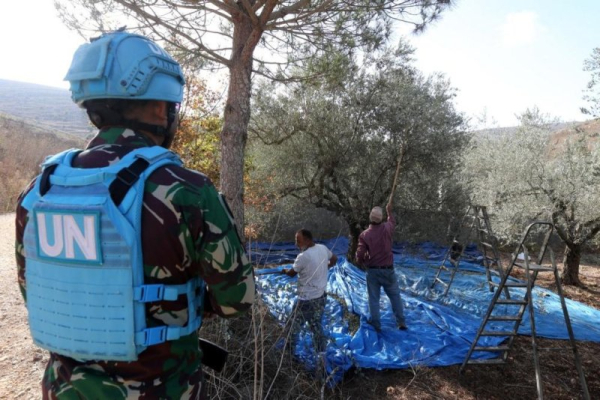
A United Nations Interim Force in Lebanon soldier stands guard as farmers harvest olives in the village of Odaisseh, located close to the Blue Line border with Israel, in southern Lebanon, in October. File Photo by Wael Hamzeh/EPA
Lebanon’s agriculture sector emerged as another victim of Israel’s widespread attacks across southern Lebanon, damaging vast areas of farmland, displacing the majority of the region’s farmers and threatening the country’s food security, economic resilience and cultural identity.
The sector, which is key to Lebanon’s economy and plays a vital role in sustaining rural communities and preserving cultural traditions, had not yet recovered from the impacts of the 2023-2024 war between Hezbollah and Israel when it was again hit by resumed hostilities in March.
The fresh escalation severely disrupted farming activities, with an estimated 22.5% of agricultural areas (56,264 hectares) damaged, including farms and greenhouses, and nearly 80% of farmers (more than 6,593) displaced and unable to access their land due to Israeli military activities, according to an updated report released by the Lebanese Ministry of Agriculture on May 5.
The report indicated that the most affected crops in the south are bananas (95%), citrus trees (97%), olives (91%) and small-scale farming, which accounts for 80% of Lebanon’s total agricultural area.
Moreover, more than 1.8 million heads of livestock (cows, goats, sheep and poultry), 29,121 beehives, and 2,030 tons of fish have been lost.
Nizar Hani, the minister of agriculture, said the sector suffered its biggest losses compared with previous wars, adding that agricultural losses have doubled since the March 2 escalation to about $1.5 billion, out of an estimated total war damage that exceeds $20 billion.
Hani said Israel is establishing a buffer zone in southern Lebanon “empty of any life, where no one can pass through, hide or live,” through destruction of entire villages, properties, orchards and olive trees.
He said southern Lebanon produces 70% of the country’s citrus fruits and 90% of its bananas, supplying the local market and exporting to neighboring countries such as Syria, Jordan and Iraq.
And he told UPI that the heavy agricultural losses, inflation, and resulting job losses had a direct impact on food security, with 24% of people living in Lebanon — including Syrian displaced persons, Palestinian refugees and others — requiring immediate assistance.
According to an analysis by the Agriculture Ministry, in collaboration with the U.N.’s Food and Agriculture Organization and the World Food Programme, 1.24 million people were expected to face food insecurity between April and August 2026, marking a significant increase from the November 2025-March 2026 period, when an estimated 874,000 people experienced acute food insecurity.
Nora Ourabah Haddad, the Food and Agriculture Organization representative in Lebanon, warned that damage to irrigation systems, productive infrastructure, livestock systems and agricultural supply chains is further weakening local production capacity.
Haddad referred to substantial declines in the production of milk, meat, eggs and honey after 1,600 farms were affected and more than 1.8 million animals killed during the war.
She said the scale of the damage is “extremely serious” and extends far beyond the affected agricultural land that included some of the country’s most productive farming areas.
“What is at stake today is Lebanon’s capacity to sustain local food production, protect rural livelihoods and preserve the resilience of its agrifood systems at a time when the country is already heavily dependent on food imports and facing severe economic pressures,” she told UPI in an interview.
Haddad said food prices rose by 8.4% in the first quarter of 2026, while transport costs increased by 21%, adding that higher fuel and logistics costs expected to continue to drive up prices.
This time, farmers fear prolonged displacement after being forced to leave their land and homes under Israeli evacuation orders in early March — as many were preparing for the planting season.
Hussein Salameh, head of an agriculture cooperative in the Bint Jbeil-Marjeyoun area, recalled how they fled without having time to take any belongings, move their cows away or release them.
Salameh, an inhabitant of the village of Aitaroun, said the displaced farmers mostly feel “frustrated and abandoned” after exhausting their savings on working their land and repairing their damaged homes when they first returned after the Nov. 27, 2024, cease-fire.
He noted that Hezbollah did not provide them then with any financial assistance, saying it no longer had the funds to do so.
Unlike other displaced employees or skilled workers who could still find work in their areas of refuge, they have lost their only source of livelihood away from their land, he said.
“This is a big tragedy. … Farmers have only their land to live on and survive,” he told UPI.
The fear is that when farmers remain separated from their land, livestock and livelihoods for extended periods, many gradually lose the ability to sustain themselves and may eventually abandon agriculture altogether, Haddad warned.
Helping farmers protect what remains of their livelihoods by providing emergency agricultural support and restoring the country’s agricultural capacity before losses become “irreversible” were emerging priorities for the Food and Agriculture Organization, she said.
However, soil contamination presents another major concern after Lebanon and international rights groups accused Israel of unlawfully using white phosphorus and the herbicide glyphosate during its attacks on southern Lebanon, destroying crops and damaging beehives and livestock.
“This is an international environmental crime,” Hani said, adding that Israel “sprayed everything with glyphosate.”
The destruction and uprooting of old olive trees — some of which have been cultivated and preserved across generations, and in some cases for centuries — was equally painful.
“It is the loss of a living heritage … olive trees are deeply connected to family history, local traditions, food culture and rural economies,” Haddad said, adding that their destruction carries not only economic consequences, but also profound social and cultural impacts on farming communities.
Restoration is possible, but it requires time as newly planted trees require many years before becoming fully productive.
“Some of these ancient olive trees may also contain unique genetic heritage that has adapted to local environmental conditions over centuries, making parts of this loss potentially irreversible from a biodiversity perspective,” Haddad said.
Even if hostilities were to stop today, recovery in southern Lebanon’s agriculture sector would not be immediate and would require extensive international funding and support.
Farmers would also need time to recover from the “deep psychological impact” of being uprooted from their land, after their “cultural and environmental values” were destroyed, according to Hani.
To Salameh, Israel was not just targeting Hezbollah but carrying out what he described as “collective punishment” against everyone living in the south, including those opposed to the Iran-backed group.
“Would such collective punishment ensure security for Israel? Would that bring peace?” he asked.
