

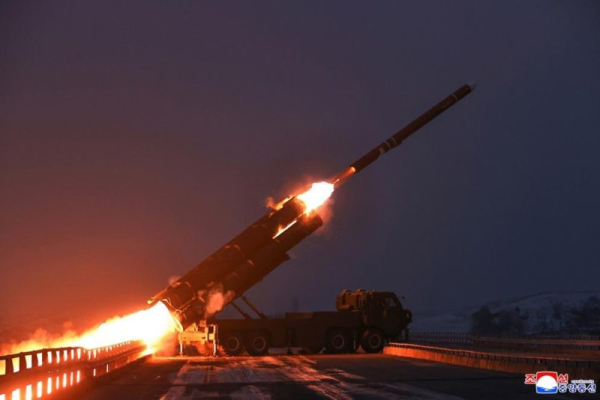
The authority in North Korea to launch nuclear missiles is similarly concentrated in one person alone: Supreme Commander Kim Jong Un. File Photo by North Korean Central News Agemcy
Iranian Supreme Leader Ali Khamenei was killed Saturday in a precision strike carried out jointly by the United States and Israel.
After months of meticulous surveillance tracking his movements and daily routines, the CIA identified the precise moment when Khamenei was presiding over a high-level meeting at his Tehran residence and executed the operation.
Khamenei had gone to extraordinary lengths to conceal himself, making a bunker accessible only by more than five minutes of elevator descent his primary refuge. Yet, even that failed to protect him.
Two months earlier, on Jan. 3, U.S. Army Delta Force conducted a raid on Caracas, Venezuela, capturing President Nicolás Maduro and transporting him to New York. As his senior military commanders were killed around him, Maduro was taken aboard the USS Iwo Jima in restraints.
For Kim Jong Un in Pyongyang, these two events are not merely international news. They are cold and unsparing previews of his own potential end. Conventional wisdom holds that a nuclear-armed North Korea renders any American preemptive strike impossible, but this is a superficial analysis that overlooks the unique physical and psychological architecture of the North Korean system.
North Korea is critically different from Iran. Iran’s system, centered on the Islamic Revolutionary Guard Corps, carries the character of collective leadership. Even after Khamenei’s death, an interim leadership council was constituted immediately and the regime has remained intact.
North Korea, by contrast, is a pathologically distorted structure in which every system is subordinated entirely to the life and death of a single autocrat. Based on my decades of direct observation in close proximity to the North Korean leadership, I can attest that the strategic missile launchers and gun barrels of the Korean People’s Army are physically configured so as not to target Pyongyang — a safeguard against accidents or internal rebellion.
The authority to launch nuclear missiles is similarly concentrated in one person alone: Supreme Commander Kim Jong Un. This means that if the “head” is struck with sufficient precision from outside, the regime’s vast weapons arsenal would instantly lose direction and be rendered inoperable.
History bears this out. When Kim Jong Il suffered a stroke in August 2008, all major functions of North Korea’s party, government and military came to a simultaneous standstill for more than two months, unable to proceed without his personal authorization.
I witnessed this firsthand in Pyongyang at the time. It is the fatal vulnerability of a state that operates not by institutional systems, but by the rubber stamp of a single dictator. If a U.S. precision strike were to render Kim Jong Un incapacitated, who, precisely, would press the nuclear button on his behalf?
The Maduro case offers an even more direct lesson. U.S. forces, acting on precise CIA intelligence, mapped Maduro’s sleeping quarters, eating patterns and movement routes in their entirety before executing the operation.
This mirrored the methodology of the Osama bin Laden raid, in which a full-scale replica of the target’s compound was built for training.
When Maduro disappeared, not a single faction chose to take up arms in revenge. Vice President Delcy Rodríguez was inaugurated as acting president and publicly declared an agenda of cooperation with the United States, holding direct talks with the CIA Director and aligning herself with the new order. The regime shattered like glass the moment its leader was removed.
In the immediate aftermath of Khamenei’s death, Iranian forces launched retaliatory missiles at Jerusalem and other major cities across the Middle East — the product of religious martyrdom ideology and a collective leadership structure.
North Korea’s elite, however, possess no such ideology of religious sacrifice. They will prioritize their own survival far above any notion of vengeance for their Supreme Leader.
Even if Kim Jong Un possesses 100 nuclear warheads, they are meaningless if they cannot protect his life. The Iranian crisis, in fact, has demonstrated that nuclear weapons are not a guarantee of survival — they can become the very justification that invites a preemptive precision strike. Iran’s pursuit of nuclear development was the direct reason it became a target of Israeli and American military action.
Imagine North Korea after the dictator is gone. The nuclear briefcase will not become an instrument of retribution. It will become the ultimate bargaining chip that the new power holders offer to the United States in exchange for their own survival, much as Venezuela’s new leadership sought the negotiating table with Washington and pursued economic agreements in the wake of Maduro’s removal.
Kim Jong Un must now confront a stark truth: His nuclear button is no longer a symbol of terror. It has become the very signal accelerating his own demise.
Ri Jong-ho is a former senior North Korean economic official who served under all three leaders of the Kim family regime. His most recent role was based in Dalian, China, where he headed the Korea Daehung Trading Corp., overseen by the clandestine Office 39 under the direct control of the ruling Kim family. Before his assignment in Dalian, Jong-ho held pivotal positions, including president of the Daehung Shipping Co. and executive director of the Daehung General Bureau of the North Korean Workers’ Party, a role equivalent to vice-minister rank in the North Korean party-state. Subsequently, he was appointed chairman of the Korea Kumgang Economic Development Group under the North Korean Defense Committee by Kim Jong Il. Jong-ho is a recipient of the Hero of Labor Award, the highest civilian honor in North Korea. Following a series of brutal purges by Kim Jong Un, he defected with his family to South Korea in late 2014. He resides in the greater Washington D.C., area.
