

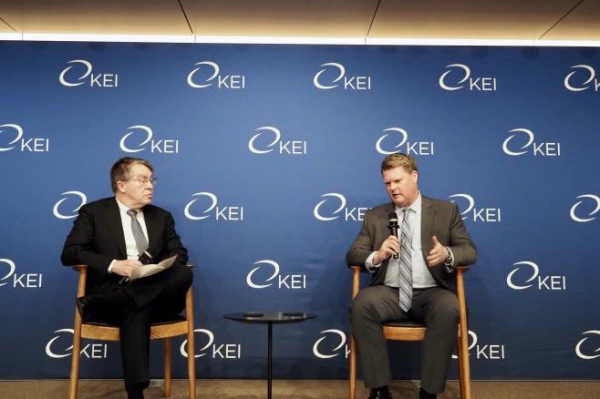
1 of 2 | Randall Schriver, president of the Institute for Indo-Pacific Security Studies, speaks with Scott Snyder, president of the Korea Economic Institute, during an event at the Korea Economic Institute in Washington on March 3, 2026. Photo by Asia Today
U.S. experts say a military operation similar to the recent U.S.-Israeli strike that killed Iran’s Supreme Leader Ayatollah Ali Khamenei would be far more difficult to carry out against North Korean leader Kim Jong Un.
While the operation against Iran may create psychological pressure on Pyongyang, analysts say the strategic environment surrounding North Korea – including its nuclear weapons, support from China and Russia and the risk to U.S. allies in Northeast Asia – makes a leadership decapitation strike far more dangerous.
The assessments were discussed Wednesday during a seminar in Washington hosted by the Korea Economic Institute and the Institute for Indo-Pacific Security Studies examining the United States’ new National Defense Strategy and its implications for the Indo-Pacific.
‘Kim Jong Un is not Khamenei’
Ellen Kim, academic director at the Korea Economic Institute, said comparisons between Iran and North Korea overlook critical strategic differences.
“North Korea possesses nuclear weapons, which makes any military option far more dangerous,” Kim said.
She added that Chinese and Russian backing for Pyongyang would significantly increase the political and military costs of such an operation.
Kim also warned that geography makes the situation far more volatile. South Korea and Japan – both U.S. allies – are within direct range of North Korean nuclear and conventional forces.
“Removing the North Korean leadership would carry enormous risks for allies,” she said.
Kim recalled that when the Bill Clinton administration considered a strategic strike on North Korean nuclear facilities in 1994, then-South Korean President Kim Young-sam opposed the plan. U.S. military estimates at the time suggested a conflict could cause up to 100 million casualties.
“Considering those risks, it would be far more difficult for President Donald Trump to consider a decapitation option against North Korea,” she said.
Yuki Tatsumi, a senior fellow at the Institute for Indo-Pacific Security Studies, said regime collapse or large-scale instability on the Korean Peninsula would be disastrous for Japan.
Given the safety concerns for Japanese citizens living in South Korea and the economic consequences of regional conflict, she said Tokyo is unlikely to support efforts aimed at regime change in Pyongyang.
Alliance shifting toward industry-based cooperation
Experts also said the U.S.-South Korea alliance is entering a new phase that emphasizes mutual economic and industrial cooperation rather than disputes over defense cost-sharing.
Randall Schriver, president of the Institute for Indo-Pacific Security Studies and a former U.S. deputy assistant secretary of defense for Indo-Pacific affairs during the first Trump administration, said the alliance narrative has shifted from conflict to reciprocity.
During the Moon Jae-in administration, Schriver said, disputes over defense spending and the suspension of joint military exercises strained relations.
“Engagement with President Moon was very difficult,” Schriver said, recalling Trump’s repeated complaints that the United States was not receiving adequate compensation for defending South Korea.
Under the Lee Jae-myung administration, however, Schriver said the alliance is increasingly framed as a mutually beneficial partnership.
He pointed to expanding cooperation in shipbuilding and discussions about nuclear-powered submarines as examples of a broader realignment linking security, industry and supply chains.
“In the past, defense cost-sharing dominated the headlines,” Schriver said. “Now shipbuilding cooperation is the headline.”
‘Model ally’ status brings new expectations
The U.S. Defense Department’s 2026 National Defense Strategy has also sparked debate in South Korea over Washington’s description of Seoul as a potential “model ally.”
Some officials in the Trump administration, including defense policy chief Elbridge Colby, view the label as recognition that South Korea is meeting U.S. expectations.
South Korea’s pledge to raise defense spending to between 3% and 5% of gross domestic product and its growing emphasis on self-reliant defense have been positively received in Washington.
But analysts warn the designation could also bring new obligations.
Kim said the label may signal that Washington expects Seoul to take on a larger role in regional security while the United States focuses resources on other theaters.
In the current strategy document, Israel is the only country explicitly identified as a model ally.
Wartime command transfer linked to alliance evolution
The potential transfer of wartime operational control of South Korean forces from the United States to Seoul is emerging as another key issue in the evolving alliance.
Kim said progressive governments in South Korea have often framed the transfer as a matter of national sovereignty, and Lee has identified it as a major defense policy goal.
The Trump administration’s emphasis on allies assuming greater responsibility could align with that objective, Kim said. However, she cautioned that the process will require careful coordination because it depends on condition-based verification stages and the status of joint military exercises.
Debate over U.S.-China strategy
Participants also discussed the phrase “decent peace” with China in the new U.S. defense strategy.
Michael Mazza, a senior fellow at the Institute for Indo-Pacific Security Studies, warned the concept could be interpreted as weakening Washington’s long-standing position of military primacy in Asia.
He said the United States and China remain fundamentally divided on issues including Taiwan.
Kim argued the concept should instead be viewed within a framework of deterrence backed by strength rather than confrontation.
If interpreted that way, she said, it could be compatible with South Korea’s pragmatic approach to managing relations with Beijing.
Tatsumi added that Japan tends to focus less on rhetoric and more on actual policy actions, including strengthening security cooperation with the United States, South Korea and partners such as Australia.
— Reported by Asia Today; translated by UPI
© Asia Today. Unauthorized reproduction or redistribution prohibited.
Original Korean report: https://www.asiatoday.co.kr/kn/view.php?key=20260304010000790
