

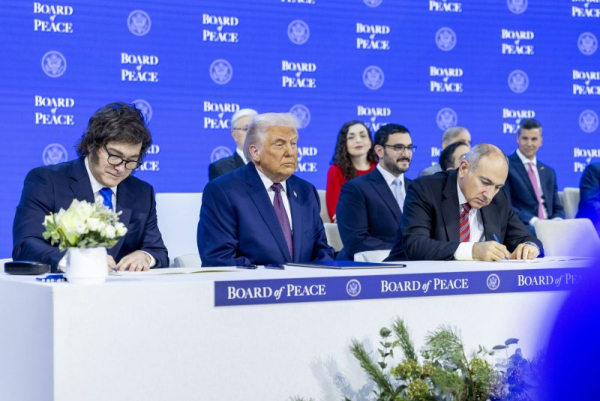
Argentina expects a significant increase in exports following the signing of a trade agreement with the United States. File Photo by World Economic Forum/Jason Alden/UPI | License Photo
Argentina expects a significant increase in exports following the signing of a trade agreement with the United States, announced by Argentine Foreign Minister Pablo Quirno.
According to Argentine government estimates, the agreement could generate more than $1 billion in additional revenue through the elimination of tariffs on 1,675 Argentine products across multiple sectors.
The beef sector appears as one of the main beneficiaries.
“The United States government will grant an unprecedented expansion to 100,000 tons for preferential access of Argentine beef to its market. This ensures an additional 80,000 tons in 2026, added to the 20,000 tons already available, which will allow Argentine exports of this product to increase by about $800 million,” Argentina’s Foreign Ministry said in a statement.
The expanded beef quota approved by the administration of President Donald Trump could renew criticism from U.S. cattle producers, who voiced opposition in October when Trump first proposed increasing beef imports from Argentina as part of a strategy to ease domestic prices.
Argentina’s Beef Exporters Consortium welcomed the agreement, saying it achieved “a significant improvement in access for our beef to the United States market.”
“The volume subject to tariff preferences had already been exceeded by our exporting companies, so expanding this quota is good news for an industry facing a very difficult environment due to reduced cattle supply affected by decades of adverse policies,” the group said, according to a report by specialized outlet Border.
In 2025, Argentina exported about 45,000 tons of beef to the United States with revenue near $345 million, a figure that could now double.
The agreement also includes benefits for other strategic sectors such as natural resources, steel and aluminum, Argentine newspaper Clarín reported.
Argentina, in turn, will reduce or eliminate tariffs on 221 product categories from the United States, including machinery, transport equipment, medical supplies and chemical products. Partial tariff cuts for auto parts and specific import quotas for certain goods are also planned.
U.S. financial institutions will also support investment financing in key Argentine sectors. Argentine officials said the agreement “consolidates the strategic alliance and mutual trust with the United States” and places the country among a select group with preferential access to the U.S. market.
President Javier Milei said the agreement will “reduce tariff and non-tariff barriers, facilitate trade in goods and services, modernize customs procedures and promote investment in strategic sectors such as energy critical minerals infrastructure and technology.”
However, the deal also requires Argentina to open parts of its market to U.S. goods and services and includes commitments on intellectual property, digital trade, labor, environmental standards, geographical indications and obligations toward third countries, Argentine outlet Perfil reported.
Argentina will also need to adopt U.S. regulatory standards, certifications and practices. On investment, institutions such as the Export-Import Bank of the United States and the U.S. International Development Finance Corporation, working with private partners, “will consider supporting financing for investments in key sectors in Argentina,” the agreement states.
Argentina’s Foreign Ministry said the accord “improves our country’s integration into supply chains” and creates opportunities for new export markets and products.
Still, the pact, expected to be sent to Argentina’s Congress in March, has sparked debate because it includes provisions authorities describe as “complex to implement,” which could delay full application. Some analysts say benefits may be concentrated in certain sectors, while Argentina will also assume commitments such as opening its market to U.S. goods and adjusting regulations that could affect the domestic industry.
Despite those concerns, the Argentine government views the agreement as a key tool to boost exports, attract investment and strengthen the country’s position in global trade.
