

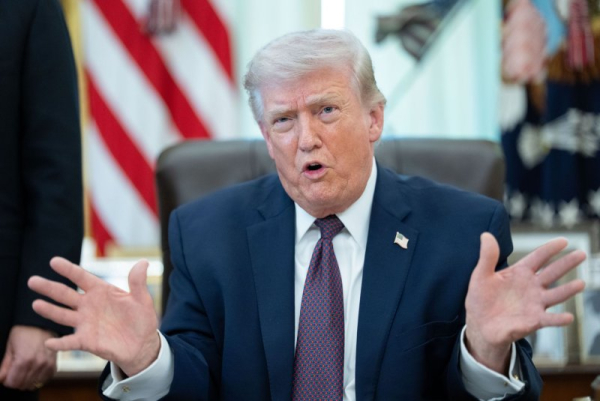
President Donald Trump said Tuesday that U.S. forces would be out of Iran “soon” with military operations ending in as little as two or three weeks. Photo by Aaron Schwartz/UPI | License Photo
President Donald Trump said the United States would be out of Iran “soon” with military operations ending in as little as two or three weeks, with or without a deal, provided he had certainty a nuclear weapon is many years away for the regime.
Speaking in the Oval Office on Tuesday, Trump said he was ready to wind down the war because the United States had achieved its military goals, including drastically setting back Iran’s ability to build a nuclear weapon, as well as “regime change” following the killings of Iran’s senior political and military leadership.
“We’re finishing the job, and I think within maybe two weeks, maybe a couple of days longer, to do the job. We’ve set them back 15-20 years. They have no navy, no military, no air force.
“We’ll leave whether we have a deal or not. It’s irrelevant now, it’s possible that we’ll have a deal because they want to make a deal,” he added.
On the Strait of Hormuz, which Iran has effectively closed to international shipping since the United States and Israel launched their airborne offensive on Feb. 28, Trump said the United States “will not have anything to do with” the vital sea lane, saying it was down to the countries that depend on it for their energy supplies.
“If France or some other country wants to get oil or gas, they’ll go right up through the strait and they’ll be able to fend for themselves. I think it’ll be very safe, actually. But we have nothing to do with that,” said Trump.
Trump’s comments came after Iranian President Masoud Pezeshkian told European Council President Antonio Costa in a call that Tehran had the “necessary will” to end the war provided it received assurances that it would not be attacked again in the future.
“We possess the necessary will to end this conflict, provided that essential conditions are met, especially the guarantees required to prevent repetition of the aggression,” Pezeshkian said.
Costa said in a post on X that he had urged Iran to de-escalate and show restraint by halting its “unacceptable attacks” on its Gulf neighbors and said that the European Union “stands ready to contribute to all diplomatic efforts to reduce tensions and for a lasting solution to end the hostilities, while addressing the broader security concerns posed by Iran.”
How much weight statements by the reformist president Pezeshkian carry was unclear given the real power in Iran lies with the hardliners, the clerics and the Islamic Revolutionary Guard Corps.
However, the developments had an immediate impact on the markets, sending the cost of Brent crude, the benchmark oil price, back below $100 per barrel for a while overnight and global stock markets soaring.
The Dow Jones Industrial Average ended Tuesday’s session up 2.49%, the S&P 500 up 2.91% and the NASDAQ surged by almost 4%. In Asia, the Nikkei 225 rocketed by more than 2,700 points overnight to end Wednesday 5.31% higher. European stocks carried forward the momentum when markets opened with the FTSE 100 in London and the DAX in Frankfurt trading 1.93% and 2.42% higher.
Brent futures for June delivery were trading at $103.31 per barrel in mid-morning trade in London on Wednesday.
This week in Washington
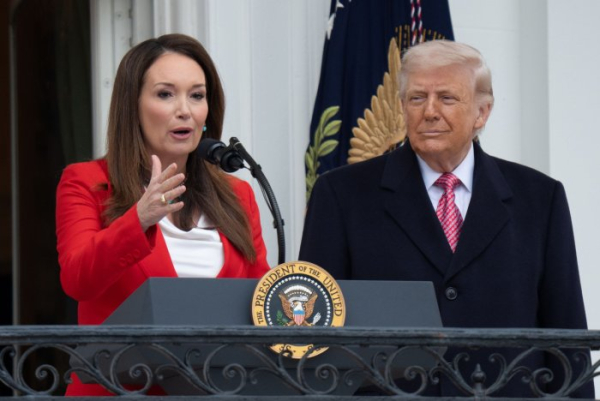
President Donald Trump stands with U.S. Secretary of Agriculture Brooke Rollins during an event celebrating farmers on the South Lawn of the White House on Friday. Photo by Aaron Schwartz/UPI | License Photo
