
Volker Türk also warns of “very dangerous” unfolding situation in the West Bank.


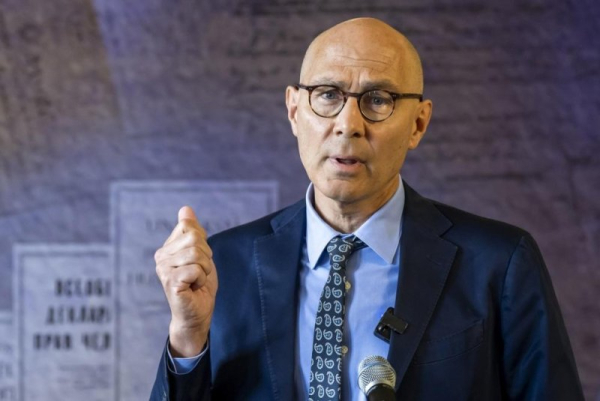
U.N. High Commissioner for Human Rights Volker Turk, during a visit to Lebanon that ended Monday, voiced concern about Israel’s repeated pattern of forced displacement, demolitions, territorial control and denial of returns in the southern portion of the country, File Photo by Martial Trezzini/EPA
U.N. High Commissioner for Human Rights Volker Türk voiced concern about Israel’s repeated pattern of forced displacement, demolitions, territorial control and denial of returns in southern Lebanon, drawing parallels to Gaza and warning of a “very dangerous” unfolding situation in the West Bank.
Türk said in an interview with UPI before he concluded a two-day visit to Beirut on Monday that “large-scale serious violations” of international humanitarian law by Israel in southern Lebanon had been recorded, some of which could possibly amount to war crimes and, under certain circumstances, may also constitute other crimes under international law.
“I am worried about the repetition of the pattern that we have seen in Gaza, especially the issues of displacement, demolitions and destruction, as well as the fact that health workers and journalists have been killed,” he said. “We saw very similar tendencies in Gaza.”
The Israel-Hezbollah war, which began Oct. 8, 2023, escalated dramatically March 2 after the U.S.-Israeli war on Iran began with the killing of Iran’s Supreme Leader, Ayatollah Ali Khamenei.
More than 4,333 people have been killed and 12,236 injured in Lebanon since March, according to national authorities. Those killed include more than 135 healthcare workers, as well as numerous journalists and media workers. Another 410 healthcare workers have been injured, while 17 hospitals have been damaged.
The escalation also displaced some 1.2 million people, forcing them to flee their homes and villages under rapid Israeli evacuation orders, while dramatically expanding the scale of destruction in southern Lebanon.
Some 70 villages were reduced to ruins by advancing Israeli troops, entire neighborhoods were leveled, and businesses, public infrastructure, schools, hospitals and roads suffered extensive damage.
Despite an initial U.S.-brokered cease-fire in April and the later signing of a comprehensive framework agreement June 26, Israel continued attacks and demolitions across southern Lebanon.
Türk said the impact on people in Lebanon has been “devastating,” citing an “extremely troubling” pattern of massive displacement and warning that some parts of southern Lebanon have become “uninhabitable.”
He noted that many residents have faced repeated displacement twice and even three times since 2023, while others tried to return to their villages, but were sent back because of the massive destruction of their villages.
“The fact that you know you can go back, resume your life and then get displaced again is extremely debilitating for people. It is a trauma that does not heal. It is human suffering,” he said. “If we don’t address their grievances, those grievances will continue to fester because they have lost everything … everything.”
The U.N. human rights chief emphasized that evacuation orders must be issued in a manner that gives people adequate time to leave in compliance with international humanitarian law, noting that “this particular aspect,” along with Israeli forces’ continued occupation of significant Lebanese territory in the south, “will be looked at” by his office.
“I am concerned that the overall conduct resulting in large-scale displacement and the denial of returns could amount to international crimes,” he said.
Türk, who said he was struck by the widespread destruction and the compounded suffering, trauma, frustration and despair of displaced people, expressed hope that the upcoming Lebanon-Israel talks in Rome on Aug. 4 would lead to de-escalation, the withdrawal of Israeli troops, the full empowerment of the Lebanese state and respect for international humanitarian law.
He was referring to mounting fears in Lebanon that a new Hezbollah-Israel escalation could prompt Israel to advance north of the Litani River and carry out further destruction in villages.
The Office of the High Commissioner for Human Rights has been conducting independent monitoring and documenting alleged violations of international humanitarian law and human rights law by all parties to the conflict in Lebanon, including Hezbollah.
Türk said that Hezbollah has obligations under international humanitarian law and that its “own combat activity and military installations” would also be investigated. He noted that the group must take “particular precautions” to ensure that it does not establish military installations in civilian areas and has a duty of care toward civilians.
Besides house demolitions and destruction of arms caches, Israel has been targeting a sophisticated network of underground tunnels built by Hezbollah over decades for weapons storage and command centers, destroying some of them in massive explosions.
Türk said there is “a legitimate security concern” for Israel, as it has a responsibility to protect its country and people. However, international humanitarian law is clear, and the fundamental principles of precaution, distinction and proportionality must be upheld.
He said the displacement of 1.2 million in Lebanon was “huge,” while displacement in Israel — estimated at between 60,000 and 80,000 at the height of the 2023-2024 conflict — “was not to the same extent” and “there was hardly any displacement” during the March escalation.
“It’s clear for us that serious violations of international humanitarian law occurred,” he said.
Asked whether Israel would one day be held accountable, he pointed to what he described as “an enlightenment” within Israel regarding the conduct of warfare, noting that many Israelis have written to his office to express concern about the trajectory of the current Israeli government.
“The interest of Israel is to actually have a real serious discussion about how the society wants to go on and not pursue war as the method to ensure its security,” he said. “We know that this never works, has never worked in any other situation.”
Türk warned of “a very, very dangerous situation” in the West Bank, where the same pattern of Israeli forced displacement and control of Palestinian territory is taking place, a process he described as “essentially through annexation.”
Asked whether the Gaza case — described as genocide by several U.N. experts, human rights organizations and legal scholars — was a wake-up call or a turning point that changed world public opinion, he said, “I think it has led to a fundamental reconsideration of a moment where you can say, ‘This cannot continue.'”
Türk said “the world has somehow lost its moral and ethical compass,” which the United Nations has provided for 80 years, adding that the vast majority of people around the world do not want to choose war over peace, but instead want peace, prosperity and to get on with their lives.
When asked about the proliferation of small, low-cost, and increasingly accessible drones capable of causing significant destruction and loss of life, he said he was “very worried” and called for the prohibition of such “autonomous lethal weapons,” stressing the need to fight for such a ban.
