


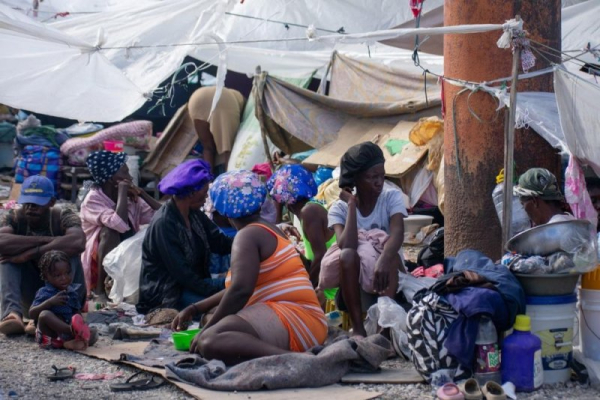
People displaced by violence live in a refugee camp in Port-au-Prince, Haiti, in late May Haiti faces brutal gang violence, deteriorating living conditions for millions of people and an inadequate international response to these protracted crises, Amnesty International has reported. Photo by Jonet St Elois/EPA
The Americas was the world’s leading region for forced displacement in 2025, with 22.8 million refugees, asylum-seekers, internally displaced people and needing international protection, the United Nations refugee agency reported Friday.
The figure represents an increase from the 21.9 million recorded a year earlier. The rise was driven primarily by crises in Venezuela, Haiti, Nicaragua, Colombia and northern Central America.
The annual report by the United Nations refugee agency also showed a significant shift in the global forced migration landscape: Colombia became the world’s leading host country for refugees and people in need of international protection.
Los países vecinos de las zonas en conflicto están haciendo su parte al acoger a las personas refugiadas.
Ahora le toca al resto del mundo hacer lo propio. Es el momento de mostrar solidaridad y apoyo.
Más información en el informe #TendenciasGlobales: https://t.co/9q2LnoErRa pic.twitter.com/FvPx4b1E14— ACNUR, la Agencia de la ONU para los Refugiados (@ACNUR_es) June 11, 2026
By the end of 2025, Colombia was hosting 2.8 million people, most of them Venezuelans, surpassing countries such as Germany, Turkey and Uganda.
Colombia’s position as a major host country is largely linked to the massive arrival of Venezuelans over the past decade. The agency highlighted that regularization policies implemented by Bogotá have allowed millions of migrants to gain access to documentation, employment and basic services, facilitating their integration into host communities.
Although Colombia tops the global list of host countries, it also continues to face one of the world’s largest internal displacement crises.
The Victims Unit reported that 7.2 million people continue to live in situations of internal displacement caused by armed conflict and violence, while the cumulative historical registry exceeds 8.9 million victims.
“The Americas demonstrate that solidarity and shared responsibility produce real results for people and societies,” said Juan Carlos Murillo, the United Nations refugee agency official in charge of the region.
The Venezuelan crisis remains one of the main drivers of displacement. By the end of 2025, there were 417,000 Venezuelan refugees and another 6 million people in need of international protection. Ninety-seven percent remained in Latin America and the Caribbean.
Colombia hosted the largest displaced Venezuelan population, with 2.8 million people. It was followed by Peru with 1.1 million, Brazil with 699,000, Chile with 662,600 and Ecuador with 435,800.
The Regional Inter-Agency Coordination Platform for Refugees and Migrants from Venezuela, known as R4V, estimates that nearly 7 million Venezuelans remain outside their country.
The report also notes that returns to Venezuela have increased in recent years.
However, a survey conducted by the agency in six countries found that only 9% of displaced Venezuelans plan to return during the next 12 months, while the majority remain cautious and condition their return on improvements in living conditions.
Haiti recorded one of the most severe deteriorations in the region. The number of internally displaced people reached 1.4 million, an increase of 38% compared with the previous year.
The International Organization for Migration reported this month that the number of internally displaced people has already surpassed 1.47 million, equivalent to approximately 12% of Haiti’s population, and noted that more than half are women and girls.
The agency also warned that gang violence is spreading beyond Port-au-Prince into new regions of the country.
Meanwhile, the International Committee of the Red Cross estimated in April that more than 6 million Haitians require urgent humanitarian assistance. The organization also said gangs exercise control over approximately 85% of Port-au-Prince, a situation that has contributed to rising displacement and a worsening humanitarian crisis.
The report also indicates that 987,700 people from countries in the Americas sought international protection in different parts of the world during 2025, representing approximately one in five asylum applications registered globally.
Venezuela, Cuba, Mexico, Haiti and Colombia rank among the main countries of origin.
Despite the increase in displacement, the United Nations refugee agency highlighted the Americas as a region that has advanced in integration policies.
The agency cited migrant regularization programs, access to employment and partnerships with the private sector, noting that more than 1,500 companies currently participate in initiatives to incorporate displaced people into the labor market across eight countries in the region.
