
The astronomical scientific community broadly opposed the hydrogen and green ammonia initiative.

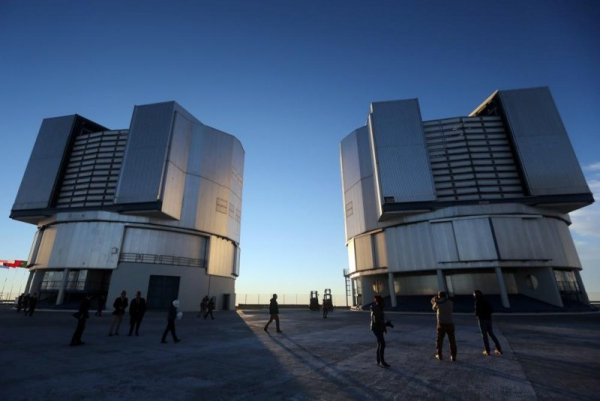
People walk near two of the four telescopes of the Paranal Observatory in Antofagasta, Chile. Astronomers had feared that the INNA project, now canceled, would have generated light pollution that could interfere with observations of dark skies. File Photo by Mario Ruiz/EPA
AES Andes, the Chilean power generation unit of the U.S.-based AES Corp., has decided to abandon plans to develop the controversial INNA project, a large-scale green hydrogen and green ammonia initiative in Chile’s northern desert.
The project, planned for the Antofagasta region, would have cost an estimated $10 billion to build an industrial complex capable of producing about 100,000 metric tons of green hydrogen and 650,000 metric tons of green ammonia per year. It also included constructing solar and wind parks and battery storage systems.
From its early stages, the initiative faced controversy and strong political and scientific opposition after environmental permitting began in 2024.
Chile’s astronomical scientific community broadly opposed the project because it was to be located about 6 miles from the Paranal Observatory, operated by the European Southern Observatory and considered one of the world’s most important astronomical centers. Scientists warned the facility would generate light pollution that could interfere with observations of dark skies.
“While INNA is a project that is fully compatible with other activities carried out in the area, AES Andes has decided to prioritize its efforts on the development and construction of its renewable energy and storage project portfolio, in line with the guidelines of its parent company in the United States,” the company said in a statement.
AES Andes said it will continue to focus on its Andes Solar III and Bolero BESS projects, which are expected to begin operations early this year. Construction is also continuing on four additional renewable projects: Arenales, Cristales, Pampas and Atacama BESS.
Together, these initiatives will add 2,363 megawatts of capacity, the company said. By 2027, AES Andes expects to complete more than 4,500 megawatts of renewable growth in Chile, with investments exceeding $4 billion, positioning the firm as a regional leader in the sector.
Marcos Kulka, executive director of the Chilean Hydrogen Association, known as H2 Chile, told UPI the cancellation was difficult news given the scale of the project. He said that “in the short term one of the flagship projects is lost, but the overall portfolio is not dismantled.”
“AES Andes has been clear that this decision reflects a strategic prioritization of its portfolio toward renewables and energy storage, aligned with its parent company’s guidelines, and not a loss of confidence in Chile’s green hydrogen potential,” Kulka said.
He described the move as a signal of reorganization rather than a retreat from investment plans.
“Companies are now being more selective and disciplined in how they allocate capital, prioritizing projects with better strategic alignment, greater maturity and lower overall risk,” he said, adding that the market is entering a phase in which better-designed projects are moving forward.
According to industry figures, Chile had 83 green hydrogen-related projects, including INNA, as of December. Of those, 17 were operational.
“The industry is entering a natural phase of maturation, where not all initial projects advance at the same pace,” Kulka said. “That sends a clear signal that beyond a single company’s decision, the project pipeline remains alive and moving forward.”
The announcement also prompted political reactions. Chilean Science Minister Aldo Valle welcomed the decision, citing concerns about the potential impact on the Paranal Observatory.
“We value AES Andes’ decision not to move forward with the INNA green hydrogen project, an initiative that generated broad debate due to its possible impact on the Paranal Observatory, one of the most relevant astronomical centers in the world,” Valle said.
He said Chile’s status as a global astronomical power must be preserved.
“Protecting our skies safeguards a unique scientific advantage and is a responsibility to the international scientific community and to future generations. This private decision benefits Chile, science and humanity as a whole,” he said.
Valle added that the government will continue to promote sustainable development that incorporates scientific evidence and balances innovation, energy production and protection of the country’s natural and scientific heritage.
During his election campaign, Chile’s president-elect José Antonio Kast had opposed the AES Andes initiative, saying he preferred to prioritize projects “in places where Chilean skies are not polluted.”
