

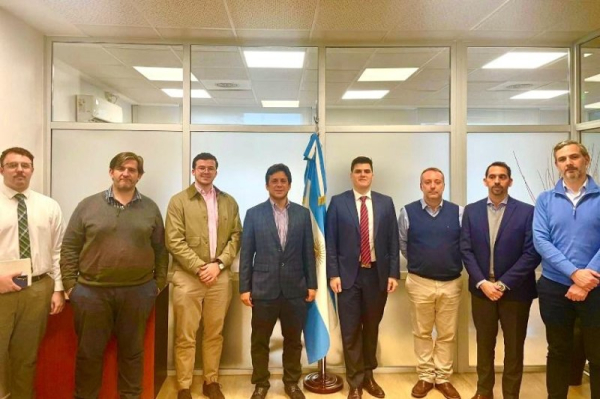
Nano Nuclear Energy corporate representatives pose in August with Dioxitek S.A. directors after the signing of a memorandum of understanding intended to lead to completion of the nuclear fuel plant in Argentina. Photo by NANO Nuclear Energy Inc.
U.S.-based Nano Nuclear Energy announced a $230 million-plus plan to restart a nuclear fuel facility owned by Argentina’s state-run Dioxitek, with a goal of boosting domestic capacity and opening export opportunities in a tight global market.
The initiative, unveiled this week, focuses on the so-called New Uranium Plant, or NPU, situated in Formosa province in northern Argentina. Construction of the facility has been stalled since 2014. The project dates to the final years of former President Cristina Fernández de Kirchner’s administration.
Contacts between Dioxitek and Nano Nuclear Energy began in August with the signing of a memorandum of understanding. That agreement allowed both sides to assess Argentina’s nuclear sector and the capabilities of the state-owned company.
Discussions gained momentum during Argentina Week, an investment forum held in March in New York, where Argentine officials promoted opportunities in strategic sectors. There, the company finalized a formal proposal that is being reviewed by the Economy Ministry.
The plan would allow the U.S. firm to participate as a production partner, while Argentina would retain ownership. The arrangement would mark a shift in Argentina’s nuclear policy, which has historically been fully controlled by the public sector.
The investment is structured in two phases. The first aims to complete construction and bring the plant online to produce uranium dioxide, a key input for nuclear power generation. The second phase would add a facility to convert that material into uranium hexafluoride, which is required for further processing.
If approved, the project could become the first nuclear initiative under Argentina’s Large Investment Incentive Regime, known as RIGI, a framework that offers tax and foreign exchange benefits to attract major investments.
Isidro Baschar, former director and training manager at Nucleoeléctrica Argentina, said the RIGI is a tool promoted by President Javier Milei’s administration to draw investment into sectors where the country holds competitive advantages.
“So far, initiatives have focused mainly on oil, gas and mining, so its application to the nuclear sector is a new development,” Baschar told UPI.
He said the Dioxitek effort is part of a broader strategy to bring private financing into unfinished projects, such as the Formosa plant. The investment aims to secure domestic uranium dioxide supply and, in a second stage, develop export capabilities linked to the nuclear fuel cycle.
Beyond the domestic scope, Baschar said the initiative aligns with renewed global interest in nuclear energy.
“It is an interesting bet in a context of renewed activity in this source as a tool for energy security, decarbonization and the development of new energy-intensive industries such as artificial intelligence,” he said.
Baschar added that Argentina has about 33,650 metric tons of uranium identified as recoverable at competitive costs. He said this volume could meet domestic demand and generate exportable surpluses if technical and environmental challenges are addressed.
Argentina’s three operating nuclear power plants consume about 220 metric tons of uranium dioxide annually, currently produced at Dioxitek’s facility in Córdoba province.
“Completing the Formosa installation would ensure that supply and allow progress toward uranium hexafluoride production, a key input in the enrichment process,” he said.
He noted that light-water reactors account for more than 350 plants operating worldwide and represent more than 80% of installed nuclear capacity. Of the 72 reactors under construction globally, about 65 will use this technology, concentrating roughly 90% of capacity under development.
If completed, the project could position Argentina in a broader and more dynamic segment of the international market, at a time of constrained supply and rising demand.
Physicist Rolando Granada, a researcher at the Comisión Nacional de Energía Atómica, said restarting the Formosa plant is “highly positive and necessary.”
However, he cautioned that foreign participation must be governed by clear conditions and preserve national decision-making capacity.
Granada said that while Argentina has uranium reserves, they are not large enough to sustain large-scale exports.
“They could supply domestic nuclear plants, but would not be sufficient to support large export volumes,” he said.
