

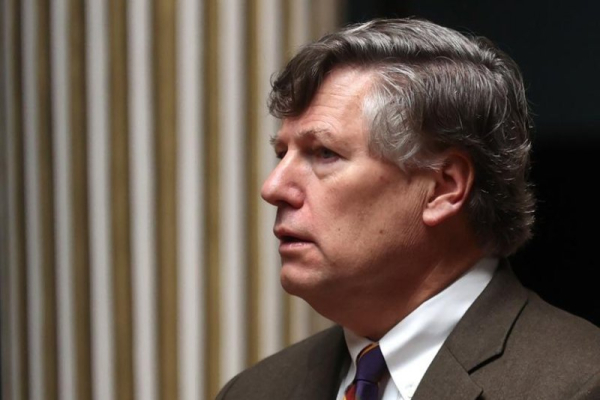
U.S. Deputy Secretary of State Christopher Landau called for a strengthening of supply chains between the United States and Chile. File Photo by Luis Gandarillas/EPA
The United States and Chile have signed a declaration to establish consultations on critical minerals and rare earths, with the aim of strengthening cooperation in supply chains and promoting essential investments between the two countries.
The signing took place Thursday during a bilateral meeting between newly sworn-in Chilean President José Antonio Kast and U.S. Deputy Secretary of State Christopher Landau.
Chile is the world’s largest producer of copper, third-largest producer of lithium and fifth-largest producer of solver.
“The development of Chile’s mining sector is obviously a major issue for Chileans. You will decide what the future of your sector will be, but I believe there is much that the United States and Chile can do together to strengthen the supply chains of those minerals that are so critical for the entire global economy, but it must obviously be for the benefit of the people of Chile,” Landau said after the meeting.
Amid geopolitical conflicts in the Middle East, President Donald Trump’s administration seeks to lay the groundwork for mutual support in the supply of key minerals for national security and commercial industries and the production of advanced technologies, including copper, silver, cobalt and lithium.
In February, the United States signed a binding memorandum of understanding related to these goals with 11 countries worldwide, four of them in Latin America: Argentina, Peru, Paraguay and Ecuador. Chile, which at the time was governed by leftist President Gabriel Boric, signed only a declaration of intent.
The new declaration signed with Chile establishes technical consultations on critical minerals and rare earths within the next 15 days. The objective is to agree on an arrangement to explore mechanisms for financing investment projects in critical minerals, including both private and state funding.
Sources linked to the discussions told the newspaper La Tercera that the United States had intended for Chile to sign the memorandum of understanding immediately. However, Chile’s new foreign minister, who formally took office Wednesday, was not able to review the document in depth beforehand.
Marcela Vera, an economist and academic at the University of Santiago, said the declaration deepens Chile’s strategic role as a producer of minerals such as copper and lithium, but should be viewed with caution given the situation between the United States and Iran.
“It is a very complex moment because what it ultimately does is establish that Chile is one of the poles supplying the inputs necessary for war to the United States, in a context where the conflict between Iran, Israel and the United States is intensifying,” Vera told the website 24horas.cl.
“It places us not only in an arena of strategic technology or the supply of a strategic resource for our country, but also in a military scenario with a high level of conflict. Therefore it is extremely dangerous in military terms,” she said.
After the meeting, Landau said the United States hopes to expand areas of cooperation with Chile. He also suggested that development of a submarine cable project that would link Hong Kong and Chile will not move forward under the Kast administration.
“We had a very important conversation with President Kast about the different opportunities for Chile to be part of the entire global communications network. He expressed to me his vision of wanting a country prepared for the digital world of the 21st century, a vision we share. The president obviously has the same priorities that we do,” Landau said.
He also said he would like to promote regional cooperation to protect the Pacific Ocean from illegal fishing, where an increase in the Chinese fleet has been observed off the coasts of countries such as Chile and Peru.
“We talked about illegal fishing in the Pacific Ocean. I believe cooperation between Chile, Peru, Ecuador, the United States and other countries could be very useful to bring together our resources and organize a plan that benefits us all,” Landau said.
