

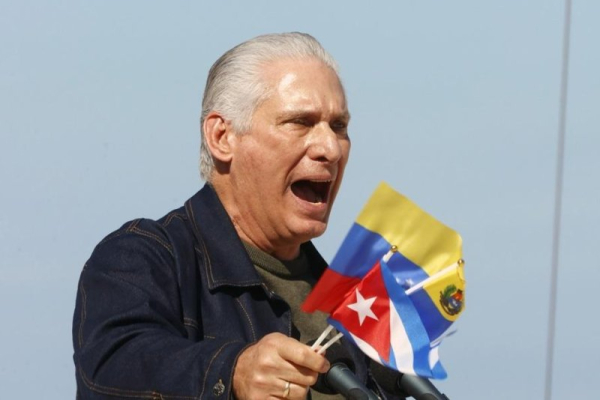
Cuban President Miguel Díaz-Canel confirmed Friday that his government is holding talks with the United States as the island nation runs out of oil and long-lasting blackouts have become commonplace. File Photo by Ernesto Mastrascusa/EPA
Cuban President Miguel Díaz-Canel confirmed Friday that his government is holding talks with representatives of the United States to address longstanding differences between the two countries.
Speaking at the headquarters of the Central Committee of Cuba’s Communist Party before members of the Council of Ministers, Díaz-Canel said the discussions “have been aimed at seeking solutions through dialogue.” He added that Havana wants to “move away from confrontation.”
“There are international factors that have facilitated these exchanges,” Díaz-Canel said during the meeting, which was broadcast on the Cuban Presidency’s YouTube channel.
The president described the talks as part of a “very sensitive process, conducted with seriousness and responsibility,” because they affect bilateral ties between the two nations that have been strained for decades after the 1959 Cuban Revolution and since the U.S. trade embargo imposed in the early 1960s.
Díaz-Canel stressed the need to determine whether both sides are willing to take joint action. He said the discussions have included identifying areas of cooperation to address common threats and ensure security and peace in both countries and across Latin America and the Caribbean.
Cuba, he said, has expressed its willingness to advance the process “on the basis of equality and respect for the political systems of both states, for sovereignty and for the self-determination of our governments.”
Díaz-Canel noted that tensions with Washington have always existed, but that “individuals and institutions have emerged that have facilitated the creation of certain channels that allow us to engage in dialogue.”
“In these moments of extreme tension, those possibilities have also emerged,” he added.
In a news conference after his national address, Díaz-Canel outlined the severity of Cuba’s energy crisis. He said the island has gone three months without receiving fuel shipments and is facing prolonged blackouts.
The electrical system is experiencing significant instability, he said, with outages that exceed 30 hours in some provinces. The blackouts have affected households, as well as production, education, transportation and medical services.
“Here, the impossible is being done,” Díaz-Canel said. He blamed what he described as an energy blockade against the island.
In late January, the United States renewed its declaration of a “national emergency with respect to Cuba,” increasing pressure on the country and restricting petroleum imports. Cuba produces roughly one-third of the crude oil it needs to meet domestic energy demand.
President Donald Trump had said in recent weeks that representatives of his administration were in contact with Cuban authorities, although Havana had repeatedly denied those claims until now.
On Thursday, the Cuban government also announced the release of 51 prisoners after contacts with the Vatican.
“In the spirit of goodwill, the Government of Cuba has decided to release in the coming days 51 individuals sentenced to deprivation of liberty. All have served a significant portion of their sentences and have maintained good conduct in prison,” Cuba’s Foreign Ministry said in a statement posted on X.
“This sovereign decision constitutes a common practice within our criminal justice system and reflects the humanitarian tradition of the Revolution,” the statement added.
