

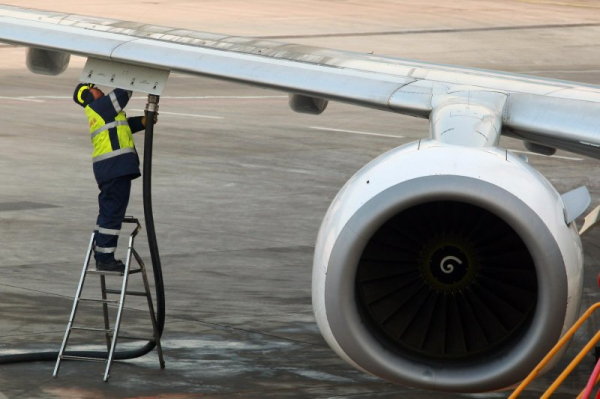
The fuel produced with biogas will be an alternative to conventional jet fuel, and it will significantly reduces aviation emissions without requiring changes to existing aircraft engines or infrastructure. File Photo by Stephen Shaver/UPI | License Photo
Uruguay will be the site of the world’s first electrified biogas‑to‑sustainable aviation fuel commercial plant after Trafigura, one of the world’s largest commodity traders, signed a six-year contract to purchase 100% of the facility’s output.
The plant is to be built in the central department of Durazno, with deliveries expected to begin in 2028.
The agreement was signed with U.S.-based Syzygy Plasmonics, which specializes in low-emissions fuel technologies. The contract guarantees full commercialization of the fuel to be produced by NovaSAF-1, the company’s first commercial-scale plant, and is considered key to reaching the project’s financial goals.
The fuel is an alternative to conventional jet fuel, and it will significantly reduce aviation emissions without requiring changes to existing aircraft engines or infrastructure, those involved in the project said.
Sustainable aviation fuel can be used directly in today’s aircraft when blended with conventional fossil jet fuel, making it one of the most immediately available options for decarbonizing aviation.
The plant is to be built in adjacent to the facilities of Estancias del Lago, one of Uruguay’s largest dairy and agroenergy companies.
The process will use biogas generated from agricultural waste as its main feedstock, combined with renewable electricity supplied by Uruguay’s power grid, which is largely based on renewable sources.
Syzygy will use its proprietary technology based on light-activated chemical reactors powered by renewable electricity.
The system already has received international precertification that allows production of renewable fuels of non-biological origin, a category considered essential to meeting the environmental regulations being adopted by aviation markets.
In its initial phase, the plant is expected to produce more than 350,000 gallons of sustainable aviation fuel per year.
According to the companies, using the fuel in aircraft as a replacement for pure fossil-based jet fuel can reduce lifecycle emissions by between 80% and 90%.
The company said the final product will be fully compatible with today’s commercial aviation fleet.
For Trafigura, the agreement is part of its strategy to expand its low-emissions fuels portfolio. The Switzerland-based group operates globally in energy trading and controls industrial and distribution assets, including Puma Energy.
“By providing commercial certainty through offtake agreements, we enable emerging technologies to secure project financing and scale up production,” Jason Breslaw, Trafigura’s global head of low-carbon fuels business development, said in a statement.
According to industry outlet Surtidores Latam, liquid biofuels are becoming a central tool for both transport decarbonization and energy security.
Agustín Torroba, technical and executive secretary of the Pan American Coalition for Liquid Biofuels, said these fuels “are a fundamental tool in the current context” because of their environmental impact and strategic contribution.
“In Latin America, adoption is particularly strong in the Southern Cone. Countries such as Brazil, Argentina, Paraguay and Bolivia have made significant progress in production and use,” he said.
