


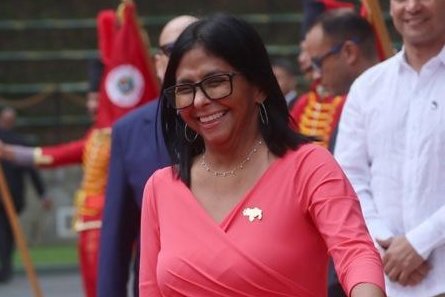
Venezuelan interim President Delcy Rodríguez said that the amnesty, enacted into law and intended to pardon alleged political crimes committed since 1999, “has come to an end.” Photo by Miguel Gutierrez/EPA
Venezuela’s interim president, Delcy Rodríguez, announced she was ending the application of an amnesty law after reporting more than 8,600 beneficiaries granted full freedoms.
Human rights organizations described the measure as arbitrary and unconstitutional. Moreover, the groups warned the decision ignores hundreds of political prisoners.
Rodríguez said Thursday that the amnesty, intended to pardon alleged political crimes committed since 1999, “has come to an end.”
She defended its implementation, saying it allowed thousands of people detained or subject to restrictive measures for political reasons to be released.
According to Rodriguez, 8,616 people received some sort of amnesty, including prison releases and the lifting of judicial restrictions, El Nacional reported.
She said excluded cases could be processed through other mechanisms, such as the Democratic Coexistence and Peace Program and the Commission for the Reform of the Criminal Justice System, established on the same day as her announcement.
However, human rights organizations questioned the government’s decision and said the law does not include an expiration date and cannot be terminated unilaterally.
“This decision does not contribute to the process of coexistence and peace,” the non-governmental agengy Provea said, describing the announcement as “an arbitrary and unconstitutional measure.”
"Esta ley de amnistía llega a su fin".
Tras el anuncio realizado por @delcyrodriguezv sobre el fin de la Ley de Amnistía, recordamos que la derogatoria de una Ley no es competencia del Ejecutivo Nacional.
Esto constituye una medida arbitraria e inconstitucional, que no… pic.twitter.com/IToJ79esiY— PROVEA (@_Provea) April 24, 2026
Similarly, the NGO Acceso a la Justicia said repealing a law is the responsibility of Parliament or the Supreme Tribunal of Justice, not the executive, while the NGO Justicia, Encuentro y Perdón warned that ending the process creates “legal uncertainty” and leaves victims in a vulnerable situation.
Criticism is also based on the number of detainees who remain in custody.The organization Foro Penal reported 473 political prisoners as of April 20, including 187 members of the military, while Justicia, Encuentro y Perdón places the figure at more than 670 people.
Balance de #PresosPoliticos en Venezuela al 20/04/2026 por :
í: 473* Desde la semana pasada
Hombres: 427 Mujeres: 46
Civiles: 286 Militares: 187
Adultos: 472 Adolescentes: 1
Encarcelaciones 1 Excarcelaciones: 6… pic.twitter.com/5aQF5i11ZV— Foro Penal (@ForoPenal) April 21, 2026
Both organizations said that thousands of Venezuelans remain subject to precautionary measures that restrict their freedom.
According to Foro Penal, more than 11,000 people remain under such restrictions, including travel bans or mandatory court appearances.
Activists also questioned the lack of transparency in the process, as authorities have not published an official list of beneficiaries despite requests from the United Nations High Commissioner for Human Rights.
The announcement came the same day that the new United States chargé d’affaires in Caracas, John Barret, assumed his duties as part of a three-phase plan promoted by President Donald Trump to stabilize the country.
