

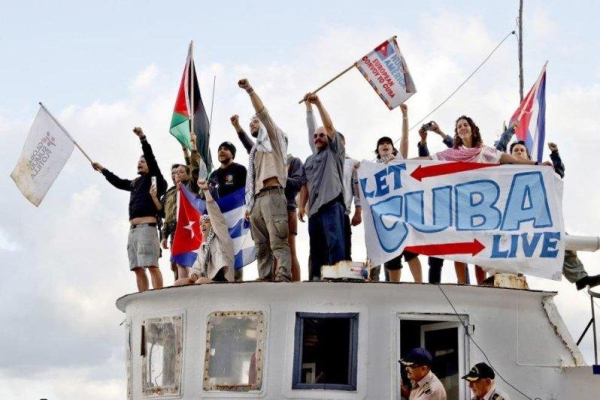
An air-sea search and rescue operation by Mexican naval vessels and military aircraft was underway Friday after two sailboats in a three-strong charity flotilla bringing aid to Cuba failed to arrive. A third vessel, an 80-foot-long shrimper, completed the journey without incident. Photo by Ernesto Mastrascusa/EPA
The Mexican Navy was searching the Caribbean and Gulf of Mexico on Friday for two missing aid boats bringing at least two tons of humanitarian aid to Cuba.
The air-sea search and rescue operation involving naval vessels and military aircraft was launched after the catamaran sailboats, Friendship and Tiger Moth, with a multinational crew of at least nine, failed to arrive in Havana on Wednesday, the navy said.
The flotilla, part of Nuestra America Convoy to Cuba, set off on the 250-mile crossing from Isla Mujeres just off Cancun on Mexico’s Yucatan Peninsula on March 20, but there had been communication from the convoy since.
A third vessel in the flotilla, an 80-foot fishing boat, arrived safely in Havana on Tuesday where the crew was personally received by Cuban President Miguel Diaz-Canel.
The navy said it was in contact with the maritime rescue coordination centers of the home nations of the crew, who are from Cuba, Mexico, the United States, France and Poland, while the Mexican government said consular authorities of the respective nations had been notified.
Before departing from Mexico, the coordinator of the mission, Adnaan Stumo, said the boats were bringing food and medical supplies.
The rescue mission comes after hundreds of activists from 33 countries converged on Havana in support of the Nuestra America effort with organizers saying they had delivered more than 20 tons of essential supplies.
The initiative brought together more than 650 participants from 33 countries, including doctors, activists, political figures, artists and digital content creators. Most participants arrived by air.
Organizers claim Cuba is on the verge of an “imminent humanitarian collapse” for which they blame the recent tightening of the United States’ decades-long economic embargo, including sanctions and restrictions on oil imports.
Mexico has already sent two vessels carrying more than 1,200 tons of food, China 60,000 tons of rice and other neighboring countries in the Caribbean are preparing to ship powdered milk, infant formula, nonperishable food, medical supplies and energy equipment, such as solar panels and batteries.
However, ordinary Cubans and dissidents criticized those efforts, particularly the Nuestra America initiative, saying they provided moral and material backing to the communist regime in Havana, which they accused of not passing on the aid to those in need.
“They believe in dictators, that’s why it works like this. None of those donations go to the people, everything goes to the stores — in MLC [a digital currency created by the Cuban government] or dollars,” said activist Yanaisy Curvelo, mother of a political prisoner.
Havana resident Manuel Soria called the Nuestra America Convoy a sham.
“What they came here for is to support the dictatorship of the Castro regime. If it comes under these conditions, then they should not come anymore because we have not seen any help. We have not benefited, what we are is hungrier every day,” he said.
Historic March moments through the years

Founder of the Women’s Tennis Association and tennis great Billie Jean King (C) smiles with representatives after speaking during an annual Women’s History Month event in celebration of the 50th anniversary of Title IX in Statuary Hall at the U.S .Capitol in Washington on March 9, 2022. Women’s History Month is celebrated every March. Photo by Bonnie Cash/UPI | License Photo
