

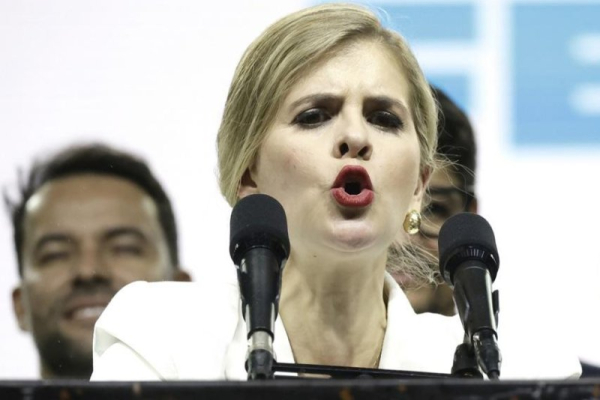
Laura Fernandez Delgado of the Sovereign People (Pueblo Soberano) party celebrates after winning the presidential elections in San Jose, Costa Rica, on Sunday. Costa Ricans also elected 57 members of the Legislative Assembly for the 2026–2030 term. Photo by Jeffrey Arguedas/EPA
Laura Fernandez Delgado was elected president of Costa Rica after winning the first round of the country’s presidential election. Fernandez will take office May 8 and will become the second woman to lead the Central American nation.
The candidate of the Pueblo Soberano Party, the ruling party of outgoing President Rodrigo Chaves, won about 49% of valid votes Sunday, which that allowed her to avoid a runoff and secure continuity of the current administration’s political project.
According to Costa Rica’s Supreme Electoral Tribunal, voter turnout reached about 69% of the electoral rolls.
With more than 93% of polling stations counted, Fernandez built a clear lead over her rivals. National Liberation Party candidate Alvaro Ramos placed second with just over 32% of the vote. Claudia Dobles of the Agenda Ciudadana Coalition followed with about 4.7%.
Fernandez, a 39-year-old political scientist and former minister of the presidency, built her political career within Chaves’ inner circle after holding key posts in the executive branch.
The ruling party framed her candidacy as a bid for continuity during a campaign marked by political polarization and a fragmented opposition.
In Congress, the results fell short of the ruling party’s goals. The Pueblo Soberano Party did not reach its target of winning 40 seats in the 57-member Legislative Assembly.
That threshold was described at different points as necessary to advance major reforms, including changes to the functioning of institutions and the justice system, according to public statements by ruling party leaders and academic analysis cited by local daily El Observador.
In her victory speech, Fernandez said her election opens the way to a “Third Republic” in Costa Rica.
“The change will be deep and irreversible,” Fernandez said, pledging reforms to the state and a push for free enterprise, trade and expanded opportunities for young people and women, digital outlet CR Hoy reported.
Economic policy featured prominently in her remarks and proposals. During 2024 and 2025, Costa Rica recorded stronger growth, falling unemployment and lower public debt, achievements Fernandez has credited to the outgoing administration.
According to the 2025 State of the Nation report, known as PEN, those figures made Costa Rica the fastest-growing economy among members of the Organization for Economic Cooperation and Development.
Fernandez called on the opposition to play a watchdog role without obstructing governance. She defended press freedom and urged newly elected lawmakers to act with prudence and responsibility in the new political landscape.
Her administration will face immediate challenges, including rising violence linked to drug trafficking and organized crime. Costa Rica closed 2025 with 873 homicides, one of the highest figures in its recent history, with a reported rate of 16.7 per 100,000 people, according to judicial authorities.
Several opposition figures have warned that an officialist victory could lead to an “authoritarian path,” Infobae reported, citing concerns fueled by Chaves’ repeated clashes with other branches of government, including Congress, the judiciary, the Supreme Electoral Tribunal and critical media outlets.
In her first statements after the win, Fernandez said she plans to follow her predecessor’s legacy over the next four years and rejected proposals for a sharp political break.
