

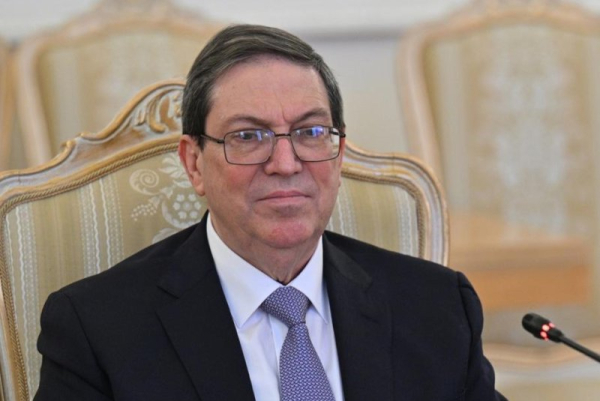
Cuban Foreign Minister Bruno Rodriguez Parrilla said Saturday that Washington has imposed a “tightened blockade at extreme levels” and an “energy siege” with humanitarian consequences for the Cuban population. File Photo by Hector Retamal/Pool/EPA
Cuba’s foreign minister has accused the United States of tightening the embargo and maintaining a “tightened blockade at extreme levels” during the 10th Summit of the Community of Latin American and Caribbean States amid an energy crisis on the island.
During his speech Saturday in Bogota, Colombia,, Bruno Rodríguez Parrilla said Washington has imposed a “tightened blockade at extreme levels” and an “energy siege” with humanitarian consequences for the Cuban population.
“History shows that Cuba is not a threat to the national security of the United States,” he said, while accusing the Trump administration of attempting to force a change of government through economic and political pressure.
Rodriguez said these measures are part of a strategy sustained for more than six decades to restrict Cuba’s access to financing, markets, technology and fuel.
In a context marked by the island’s energy crisis, which experienced the second collapse of the national electric system in less than a week and the seventh in 18 months, Argentina’s president, Javier Milei, and his Brazilian counterpart, Luiz Inácio Lula da Silva, expressed opposing positions over the weekend about the Cuban situation.
Milei presented a view aligned with Washington during his participation in the Conservative Political Action Conference in Hungary, where he described recent economic changes in Cuba as “its own Perestroika.”
“Surely, before midyear, under the leadership of that great man Donald Trump, we will probably see a free Cuba,” he said.
The Argentine president attributed the crisis to decades of domestic policies and said the Cuban model has left the population in “the most abject misery.”
Lula, however, questioned the actions of the United States in the region and defended the principle of sovereignty during remarks at an international forum linked to CELAC.
“We cannot accept that others think they own us,” he said, criticizing measures adopted by Washington against countries such as Cuba and Venezuela.
The Brazilian president also questioned the legality of military interventions and challenged the ability of the United Nations to offer solutions to international conflicts.
Amid these tensions, Rodríguez said the CELAC-Africa summit, that Cuba is willing to engage in “serious and responsible dialogue” with the United States, as long as the country’s sovereignty is respected and there is no interference in its internal affairs.
The foreign minister’s remarks add to those of President Miguel Díaz-Canel, who said that in any potential negotiation with Washington, “the Cuban political system is not subject to negotiation.”
