

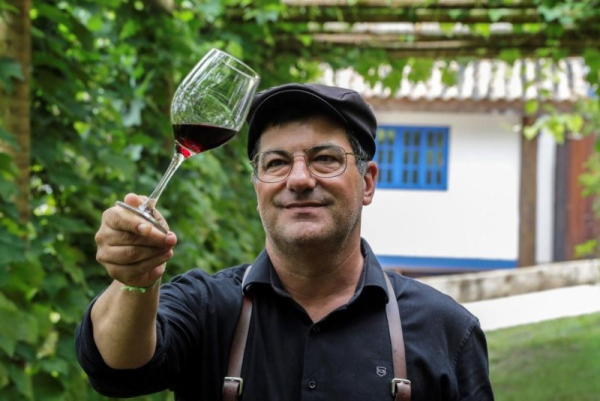
Through the new trade deal with the European Union, Mercosur would strengthen its role as a supplier of food, meat, grains, oilseeds, fruit and wine. File Photo by Sebastiao Moreira/EPA
Paraguay will host the signing of a free trade agreement between the European Union and the Southern Common Market, known by its Spanish acronym Mercosur, on Saturday after EU member states reached consensus last week.
The deal between Mercosur, comprising Argentina, Brazil, Paraguay and Uruguay and the European Union was reached in December 2024 after 25 years of intermittent negotiations.
EU member states formally approved the agreement this month, despite opposition from France, Poland, Ireland, Austria and Hungary.
The Mercosur agreement strengthens the EU’s strategy to diversify economic partners and secure stable ties amid growing geopolitical and trade tensions worldwide.
South American governments highlighted the deal’s economic potential. In a lengthy post on the social media platform X, Argentine Economy Minister Luis Caputo said the agreement will expand exports and accelerate growth.
“Under this agreement, Argentine products will gain access to a market of more than 700 million people, representing 20% of global GDP,” he said.
Caputo said the EU will eliminate tariffs on 92% of Argentine exports and grant preferential access to another 7.5%.
He said the opening will boost trade, investment and job creation. Caputo also said the deal will place Argentina on equal footing with countries that already have preferential agreements with the EU, including Chile, Mexico, South Africa, Egypt, Morocco and Ukraine.
“There will be clear rules that provide predictability and regulatory transparency in areas such as fast-track customs clearance, perishable goods, fewer physical inspections and simplified customs procedures,” he said.
Caputo added that the agreement will help small and medium-sized companies integrate into global value chains.
“It will create greater business opportunities for SMEs, while consumers will benefit from a wider range of goods and services at competitive prices,” he said.
Uruguay’s economy minister also welcomed the deal, writing on X, “This agreement is a very important step toward opening Uruguay’s economy and modernizing Mercosur.”
He said the deal will attract new investment and raise the country’s potential growth.
According to his estimates, the impact would include an increase in GDP of slightly more than 1 1/2 percentage points, a nearly 4% increase in goods exports, a 0.5% increase in employment and about a 1% gain in real wages.
Paraguay’s Industry and Trade Minister Javier Gimenez said on X that the European Union “is a market with strong purchasing power,” opening opportunities to attract investment, create jobs and promote development across the region.
Former Argentine production minister Dante Sica told UPI the agreement’s scope is significant.
“It is the last major trade agreement signed in recent years and covers nearly 700 million potential consumers,” he said.
Sica said the deal opens a key market for Mercosur and sends a signal of stability to investors.
“There is strong potential interest from European capital seeking reliable suppliers. Countries in the region can offer the confidence needed to encourage those investment processes,” he said.
Sica said European investment had declined in Latin America in recent years but the agreement aims to reverse that trend.
“The region had lost international relevance, partly because of labor informality and security problems. Now it is regaining weight. The agreement sends a clear signal of predictability to investors,” he said.
He added that nearly 70% of tariffs will fall to zero almost immediately, expanding access to the European market and allowing the use of EU inputs to strengthen value chains.
“Argentina has four dynamic ecosystems in food, energy, mining and technology that enhance its ability to attract investment,” Sica said.
Economist Ernesto Mattos, who teaches at the University of Buenos Aires, agreed.
“This agreement creates a free trade space in which Europe consolidates its position in capital goods and high-technology products, while Mercosur gains greater concessions,” he said.
Mattos said tariffs on products such as beef and poultry, corn and ethanol will be reduced or eliminated entirely. He said the Hilton quota — a European rule that limits imports of high-quality beef — will be removed.
He said the deal will facilitate imports of European inputs and capital goods and solidify a model in which the EU exports high-value technology products, while Mercosur strengthens its role as a supplier of food, meat, grains, oilseeds, fruit and wine.
Mattos highlighted interest from Argentina’s wine sector and the EU’s recognition of 104 Argentine geographical indications.
“That will help resolve longstanding disputes, such as the use of the term champagne, which in Argentina is sold as sparkling wine,” he said.
For Argentina, “this exchange will help consolidate the position of the agribusiness sector,” Mattos said.
He said the European decision also reflects growing rivalry between the United States and China.
“Europe is seeking to secure supplies of food and energy — goods that Mercosur and Latin America can provide,” he said.
Sica added that the deal reinforces long-standing Ibero-American ties between Europe and Latin America.
“Beyond the current context shaped by Donald Trump, we are seeing a reconfiguration of the global economic and political order driven by demographic and technological changes. This is a good moment to reaffirm those ties,” he said.
After the signing, the agreement must be ratified by the European Parliament and the legislatures of Mercosur countries.
If the process moves forward without obstacles, the trade provisions could begin to take effect by late 2026, including tariff reductions and other benefits.
