

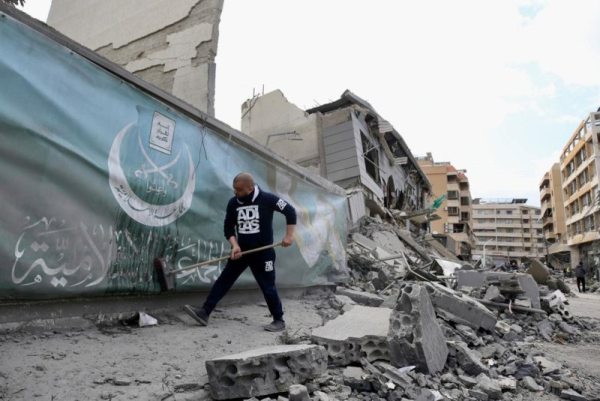
Rubble is removed from the site of the destroyed building of the Jamaa Islamiya, an Islamist group allied with Hamas and Hezbollah, after it was targeted by an Israeli airstrike Tuesday in the southern coastal city of Sidon, Lebanon, Photo by EPA
Hezbollah leader Naim Qassem said Wednesday that his Iran‑backed group has resumed fighting to compel Israel to halt its aggression and withdraw from occupied Lebanese territories, stressing that the move was unrelated to the U.S.‑led war on Iran and vowing to resist regardless of the sacrifices.
“The fighting is not related to any other battle,” Qassem said in a speech broadcast on Hezbollah’s al Manar TV. “The resistance’s main goal is to stop the Israeli-American aggression and force its withdrawal from the Lebanese territories.”
He said Israel sought “a battle pushed to the extreme” and pledged to resist “regardless of the sacrifices and despite the disparity in resources.”
It was his first speech since Hezbollah fired missiles and drones into northern Israel early Monday, triggering retaliatory Israeli strikes on Beirut’s southern suburbs and other areas that have so far killed 72 people, injured 437 and caused mass displacement.
The group, which was severely weakened during the war that erupted after it opened a support front for Gaza on Oct. 8, 2023, has kept a low profile and refrained from retaliating to Israel’s almost daily attacks since the Nov. 27 cease-fire agreement.
It has refused to lay down arms south of the Litani River — where the Lebanese Army completed its deployment — as long as Israel does not abide by the truce accord brokered by the United States and France.
Israel has been operating with near-total freedom in Lebanon and imposing its own terms, insisting on Hezbollah’s complete disarmament.
Qassem said Monday’s missile firing was in response to 15 months of Israeli truce violations in Lebanon during which 500 people were killed and the assassination of Iran’s Supreme leader Ayatullah Ali Khamenei in a U.S. air strike on Tehran on Feb. 28.
He said that “patience has limits,” and that the diplomatic process pursued by the Lebanese government had failed to “achieve anything,” noting that Israel already was preparing for this round of war when it called up 100,000 reservists on its northern border.
Qassem accused the government of having committed “a great sin” when it made the decision to disarm his group last August.
Shortly after his speech, the Israeli Army confirmed it struck a Hezbollah operative, targeting his car in Beirut.
Early Wednesday, Israel escalated its attacks, targeting overnight three residential buildings in densely populated areas south of Beirut, the eastern city of Baalbek and a hotel in Beirut’s eastern suburb of Baabda, where the Presidential Palace is situated.
The Israeli strikes were carried out without warning and reportedly targeted Hezbollah members, as well as an Iranian diplomat or a member of the Revolutionary Guard who was staying at the Comfort Hotel. There has been no confirmation from either Hezbollah or Israel.
The Israeli military also conducted a wave of air strikes on villages in south Lebanon and Hezbollah’s stronghold in Beirut’s southern suburbs, where it said it targeted the group’s “infrastructure.”
The Lebanese Health Ministry released a new casualty toll, saying that 72 people have been killed and 437 wounded in Israeli strikes since the recent escalation began Monday. More than 300,000 people have been displaced, including 83,000 — or 18,033 families — registered in government-designated shelters.
The Israeli Army issued additional evacuation orders, warning all residents of southern Lebanon to evacuate more villages immediately and move north while its troops advanced farther into Lebanese territory — a move that reportedly aims to establish a border buffer zone.
Meanwhile, Hezbollah announced that it had carried out 11 military operations targeting Israeli army positions, bases and troop concentrations in Mutella and Safad in northern Israel and south of Tel Aviv, using rockets, missiles and drones.
The group said its fighters hit an Israeli tank in the Lebanese border town of Houla and others clashed with Israeli forces in the town of Khiam in a first claim of direct confrontation with the advancing Israeli soldiers.
Israeli English‑language websites reported that Iran and Hezbollah launched near‑simultaneous attacks on Israel, firing missiles that were intercepted, with only slight damage reported.
The Lebanese Army said in a statement that its units were repositioning at some border points, describing Israeli infiltration inside southern Lebanon as “a blunt violation” of international resolutions and the country’s sovereignty.
The Army also arrested 26 Lebanese and one Palestinian for illegal possession of weapons and ammunition at its checkpoints.
On Monday, the Lebanese Cabinet prohibited Hezbollah from all military activities, hours after the Iran-backed group fired missiles and drones into northern Israel, triggering massive retaliatory Israeli strikes on Beirut’s southern suburbs and other areas .
Hezbollah was accused of dragging the country into the U.S.-led confrontation with Iran.
