

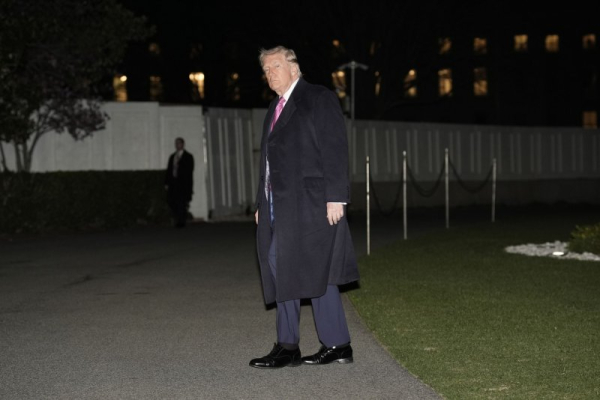
US President Donald Trump walks on the South Lawn of the White House upon his return to Washington, D.C., from Florida on Sunday. Photo by Yuri Gripas/UPI | License Photo
White House press secretary Karoline Leavitt said the U.S. military would “operate within the confines of the law” after President Donald Trump threatened to target Iran’s electricity plants, oil wells and “possibly” desalination plants Monday morning.
In a post on his Truth Social platform, Trump threatened to “obliterate” Iran’s energy infrastructure if “great progress” made in serious discussions with the “new and more reasonable regime” failed to produce a cease-fire in the very near future.
“Great progress has been made but, if for any reason a deal is not shortly reached, which it probably will be, and if the Hormuz Strait is not immediately ‘Open for Business,’ we will conclude our lovely ‘stay’ in Iran by blowing up and completely obliterating all of their Electric Generating Plants, Oil Wells and Kharg Island (and possibly all desalinization plants!), which we have purposefully not yet ‘touched,'” Trump wrote.
NBC News asked Leavitt why Trump was threatening to destroy civilian infrastructure, which could be a war crime under international law. Leavitt said Trump made it “quite clear” to Iran that “their best move is to make a deal or else the United States Armed Forces has capabilities beyond their wildest imagination, and the president is not afraid to use them.”
“Of course this administration and the United States armed forces will always act within the confines of the law,” Leavitt said. “But with respect to achieving the full objectives of Operation Epic Fury, President Trump is going to move forward unabated, and he expects the Iranian regime to make a deal with the administration.”
When asked which of Trump’s objectives would be aided by destroying desalination plants, which convert sea water into drinking water, Leavitt declined to answer.
Iranian President Masoud Pezeshkian told a cabinet meeting Monday that Iran has conditions for ending the war, NBC reported.
“Any decision regarding ending the war will be made only by considering all stated conditions and within the framework of ensuring the dignity, security and interests of the great Iranian nation,” Pezeshkian said.
Speaking to the Financial Times on Sunday, Trump said seizing Iran’s oil was his “favorite thing” and that the move might involve taking and holding the island in the Persian Gulf, adding that he thought American forces would meet little resistance.
“To be honest with you, my favorite thing is to take the oil in Iran,” he said, likening the idea to the military operation in Venezuela in January in which the United States took control of its oil industry and stocks.
Trump derided those in the United States who were skeptical about doing the same in Iran as “stupid people.”
“Maybe we take Kharg Island, maybe we don’t. We have a lot of options. It would also mean we had to be there [in Kharg Island] for a while,” Trump said, adding that he didn’t think “they have any defense.”
However, unnamed sources said the mission would be “very risky, given it is within range of Iranian drones and missiles, while not necessarily yielding any material change on the ground in that it would not alter Iran’s effective blockade of the Strait of Hormuz.
Even if the United States wanted to ship oil out from Kharg Island to ease global supply pressures pushing the price of Brent Crude above $115 on Monday, tankers moving from U.S.-controlled territory in the Gulf could still have to run the gauntlet of potential Iranian attacks as they navigated the strait.
The war launched by the United States and Israel against Iran continued to escalate in the region, including an Iranian strike on a Kuwaiti power and desalination plant that killed at least one person.
