

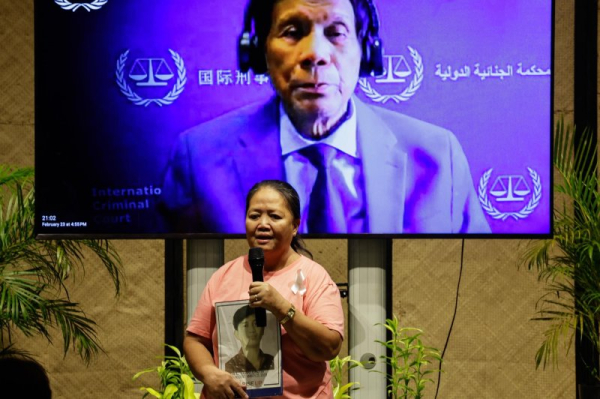
1 of 7 | Dahlia Cuartero, mother of a victim of an alleged extrajudicial killing during the war on drugs campaign of former Philippine president Rodrigo Duterte, holds a picture of her son before watching a broadcast of an International Criminal Court proceeding from Quezon City, Manila, Philippines, Monday. Duterte’s confirmation of charges hearing at the ICC at The Hague opened Monday, as the former leader is facing charges of crimes against humanity. Photo by Rolex Dela Pena/EPA
The pre-trial hearings for former Philippine President Rodrigo Duterte are set to begin at the International Criminal Court Monday, though he has refused to attend.
Duterte, 80, said he won’t attend because he is “old, tired and frail” and has memory loss. He said “the claim that I oversaw a policy of extrajudicial killings is an outrageous lie.” He also said he doesn’t recognize the ICC’s jurisdiction.
Duterte was arrested in Manila and taken to The Hague last year. He is facing charges of crimes against humanity for his role in a “drug war” crackdown in which thousands were allegedly killed for selling or using drugs. In January, the court denied his release saying he is a flight risk.
Victims’ families have called Duterte a coward for refusing to appear.
“He should face everything he did to us and to the families of the [other] victims,” Sarah Celiz, 61, whose two sons Almon and Dicklie were killed in 2017, told The Guardian.
His supporters have asked for sympathy for Duterte because of his age and health.
“He never showed us any mercy,” Celiz responded. “My son begged for mercy, but he showed none. So why should we show him mercy? No.”
Judges agreed to let Duterte waive his right to attend the hearings. The ICC ruled in January that Duterte is fit to take part in pre-trial court proceedings.
The hearings will decide if there is enough evidence to charge Duterte. If the court decides the charges are valid, the case will move to the trial phase. This week’s hearings are expected to last five days.
In March, Duterte was arrested on the ICC’s warrant after a formal investigation that began in September 2021. In October, the court denied his release because he was deemed a flight risk.
The national police force in the Philippines said Duterte killed about 6,000 people in his war on drugs, but human rights groups say it was 30,000.
Last week, Duterte called his arrest a “kidnapping” and said it was facilitated by President Ferdinand Marcos Jr. He said he was “forcibly pushed into a jet and renditioned to The Hague in the Netherlands in flagrant contravention” of the Philippines’ constitution and sovereignty, The Guardian reported.
“I have accepted the fact that I could die in prison. But those that desire this fate for me should know that my heart and soul will always remain in the Philippines,” he said.
When he left office four years ago, he had an 88% approval rating. His daughter Sara Duterte is the vice president of the country, an office she won in a landslide, The New York Times reported. She could become president in 2028.
Many Duterte supporters in the Netherlands are protesting in support of the former president at The Hague.
“It’s a simple sacrifice to stand in the rain for a couple of hours for a Filipino who was taken without standing trial in his country,” Aldo Villarta, 35, told The Times in a phone interview. “If they can do it to him, someone who has power, what can they do to a regular person like me?”
Some victims’ families who have spoken out worry about retaliation if Sara Duterte wins.
“Since my sons died, fear is no longer in my vocabulary,” Celiz told The Guardian. “[The ICC] is our only hope to obtain justice for the victims.”
Historic February moments through the years
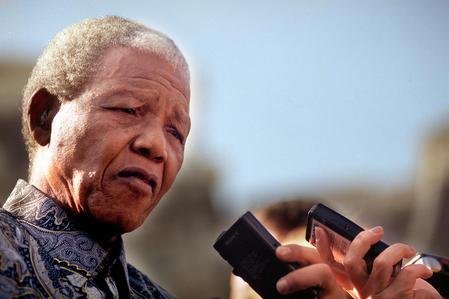
Former South African president Nelson Mandela speaks to reporters outside of the White House in Washington on October 21, 1999. Mandela was famously released from prison in South Africa on February 11, 1990. Photo by Joel Rennich/UPI | License Photo
